Thursday, November 5, 2020

Everglades National Park


 The Everglades are one of the most iconic natural areas in the country. When people think of them they of a tropical swamp full of alligators and mosquitos, and you wouldn't be wrong to think that. But there is so much more to the Everglades. This is an incredibly unique area, especially when compared to the rest of the country. Located just north of the Tropic of Cancer, the Everglades are home to flora and fauna that cannot be found anywhere else in the United States. 

This is the only place in the world where alligators and crocodiles coexist. The Seminoles held out for ages here due to the inaccessibility of the area. And it's less than an hour's drive from the Miami suburbs. With the Columbus Day banking holiday it was a no brainer to make the trip here to chase some of the unique birds. 

American Crocodile

We arrived at the park late morning on Saturday morning at around 11:30. Not the optimal time for birds, but the scenery made up for it. The sea of grass stretched on for miles, and we frequently saw Great Egrets and Little Blue Herons shoot up to fly away from the road. There isn't a ton of land in the Everglades. It's pretty much a massive river flowing from Lake Okeechobee down to Florida Bay. This provides ample habitat for most of the waders found in the United States, which we saw plenty of. 
Florida Softshell Turtle

But there is also a mix of hammocks, or small islands of trees that elevate about the water to provide ample habitat for many other species of birds. Our first experience with one was very productive with a stunning male Black-throated Blue Warbler. Things really picked up at our second stop, Mahogany Hammock. A stunning Prairie Warbler was very cooperative, but it was not the best bird on the trail.

A larger bird moved in the trees above the trail, which was very odd. The trees seemed too dense for anything larger than a warbler to move, and by the time my eyes registered it was a bird it was gone. TJ, likely annoyed about having to look for a bird that was likely gone, pretended to be patient. Then the dark bird flew to an opening in the canopy that left it perfectly in the light. WHITE-CROWNED PIGEON! Some people will be surprised that I got hyped over a pigeon, but it's more than just a pigeon.

White-crowned Pigeon

It's no secret that I hate established exotics like Rock Pigeon, but this is a different bird. WCPI is a primarily Caribbean species that extends north enough to be in the Everglades.. They are very secretive and apparently impossible to photograph. And here it was, basking in the sun for perfect views.

Our next stop was Flamingo, where we walked around the beach in search of shorebirds. Highlights were a lifer Red Knot, and the best views I've ever had of Black Skimmer and Wilson's Plover. For someone who is absolute garbage at identifying shorebirds it was very helpful in getting Wilson's Plover down. We also stopped at the marina for one of the better nature experiences of the trip. This is probably the easiest place to see American Crocodiles in the United States, and we were really fortunate to see 2 of them. They are finally rebounded after nearly being extirpated in the 1970s. On the other side of the bay we got to see at least 10 West Indian Manatees frolicking in the water.

Wilson's Plovers

I could hardly sleep that night, as Sunday brought the search for the most sought after bird: Snail Kite. Another locally threatened species, Snail Kites are found throughout central and southern Florida. Finding them can be a bit of a challenge, as they depend on water levels to find their main source of food, the Apple Snail. Finding one would be hard, as you can't actually see them in the park. The best place is along Hwy 41 on the Miccosukee Reservation just across the street from Shark Valley. Your best bet is to just drive the highway and hope you see one above the tall grass. My four eyes were a real advantage in this situation, and within 5 minutes a black raptor was spotted. I slammed on the brakes and pulled over, and sure enough it was a Snail Kite! 

Frolicking Manatees, a highlight animal of the trip

I wish I had a romantic story about how amazing it was to watch this bird for 10 minutes, but the Florida humidity had other plans. Everything from my glasses, to camera, to binoculars fogged up once we got out of the car, just in time for the bird to decide that hanging around a guy who couldn't contain his excitement was too lame for him. He took off and flew out of site, but honestly I didn't care. I got my Snail Kite. We finished the morning with a 15 mile bike ride around Shark Valley, which offered incredible views and was probably my part of the park. Birding wise it was pretty uneventful. We had tons of Palm Warbler, which I always get excited for, and 2 Yellow-billed Cuckoos.

We woke up on Monday morning after going shark diving with a pretty flexible schedule. We decided to head to John Pennekamp Coral Reef State Park on Key Largo to potentially get some last birds. On our drive down we had tons of Bald Eagles and Osprey. The park is as small as it is impressive, and it's really small. It feels way more tropical than it did in the Everglades, which makes sense given how much farther south it is. There are a few short trails, and all appeared pretty birdy. The best bird was a Short-tailed Hawk flying overhead, but we also had White-crowned Pigeon and lifer Cape May Warbler right outside of the visitor center. We finished the trip out by kayaking through mangroves, which unfortunately meant I didn't have my camera on me when 3 Magnificent Frigatebirds circled overhead. It was stunning, these massive birds look even better in person, and it was great to finally soak in views of a nemesis bird.

Anhinga

Miami is an excellent birding destination, even though we didn't go at the best time of year. I'd really suggest February, as it is likely drier so you'll get more waders in the Everglades, while still getting good winter birds with the off chance of a wandering Caribbean vagrant. Our shark diving took up a ton of time which kept us from getting Florida Scrub Jay and likely a few others, but obviously that's something you have to do. Next stop: Puerto Rico!


Thursday, October 8, 2020

Southside Wastewater Treatment Plant

 Birders are a weird bunch. We got to places and do things that a "normal" person would never, like waking up before dawn in the winter, driving across the state and back in one day, and going to some wacky locations like a dump or water treatment plant in the name of seeing birds. In the past I have gone to a dump to (unsuccessfully) look for Tamaulipas Crows, and I've been to a few water treatment plants in my brief birding career. In fact, these plants can be amazing birding locations. The tanks can hold a variety of shorebirds and ducks, and the property usually sits on some forest as well. 

Southside Wastewater Treatment Plant is one of the best, if not the best place to bird in Dallas. It's a massive property that has a wide variety of habitats, which is evident by the whopping 261 species that have been reported there. Rare birds are seemingly reported weekly, and it is one of the few places in Dallas county where you can see Wood Stork, Prothonotary Warbler, Bald Eagle, and Crested Caracara. There is one con, and that is access. You can't access it unless you gain permission, but that list is usually updated quarterly. 

No identification necessary

I finally got access starting September 1, but Washington and a major exam for work kept me indoors until last Saturday. Even then, I had to officiate a wedding that afternoon so I couldn't stay long. Matt Duross gave me a tour of the property, which he said is 15 square miles. I had a good omen at the beginning with Pileated Woodpeckers flying overhead, a county bird for me. We started out on some tanks just by the administration building that were full of shorebirds. Peeps were everywhere and we got excellent side by side looks at Greater and Lesser Yellowlegs. A Red-necked Phalarope had been seen here for a week, which would have been a Texas bird, but it was not to be found. Oh well, I saw them in Washington and at the clip rare birds show up here I'll likely get another crack at one next spring.

We continued to a field that was full of White and White-faced Ibises, more than I've ever seen. As we drove on we got excellent looks at Northern Harrier and a few Red-tailed Hawks, but our biggest prize was a pair of Crested Caracaras, possibly the only place in Dallas to see them. I have not seen them in a while, and they looked stunning in the clear sky. 

Crested Caracara

We went and looked at some empty tanks that were full of swallows, which are extremely hard to ID when they are flying in swarms. These tanks were just on the edge of the property, which borders a hunting and fishing club that offers no access. Matt said he has seen Wood Storks, very scare in Dallas County, flying over in season. I wish I had been here a few weeks prior! We drove along the levee past the nesting spot for Prothonotary Warblers on our way to the main event of the morning.

Bald Eagles don't need an introduction. But a lot of people have never seen an eagle, Bald or Golden, and underestimate their size. I've seen them up close in Maine and I've watching them soar along the Kenai River in Alaska during the salmon run and it is absolutely breathtaking. Most recently I saw one at Cullinan Park in Sugar Land as a speck in the sky. Seeing one is supposed to be a special occasion for me. But to see one in Dallas was something I thought to be very rare. I was wrong. There is a nest at Southside, and they are almost always there. You can also see them at John Bunker Sands, but to my knowledge those are the only 2 places one can expect to find them.

Anhinga

We ended up seeing not one, but two Bald Eagles sitting on power lines that allowed for extended views. We also had an Anhinga on the pond when we stopped to look at them, another county bird. We didn't spend a ton of time because my introductory tour was still not over. Our last stop was a massive pond in the center of the property. There were tons of pelicans and ducks, including Ring-necked, a county bird for me. We had a curious family of Black-bellied Whistling-Ducks with ducklings, which seems to be super late in the year for them. Matt got eyes on a Bank Swallow, which is a fantastic find. He pointed it out to me just in time to get a good look at it, and then a Tree Swallow flew into view. I was beyond pumped, as Bank Swallow is a Texas bird for me. The last big find as we left was an American Avocet, a county bird.

Ring-necked Ducks and American Coots

I saw all of the plant, but didn't have time to explore it in depth. And yet I still saw 47 species, which is probably double what I was expecting. It'll only get better as migration progresses, and I can't wait to get back when I have more time and don't have to rush home to officiate a wedding!

Monday, October 5, 2020

Washington Birding: North Cascades National Park

I had no time to waste after the pelagic trip. It was about 3:30 and I had to get on the road. Westport is in the southwest corner of the state, and my next stop, Mount Vernon, was across the peninsula and about an hour and a half north of Seattle. 

My original plan was to head to Mount Rainier, but given the holiday weekend I was told it is nearly impossible to get to certain places because it's the place to be for Seattle residents. Instead I opted to go to North Cascades, a more remote and less popular park. That meant birding info was hard to come by, but the views looked gorgeous and my goal is to visit every national park, so it would be perfect.

North Cascades National Park

I wanted to get to high elevation places, and unfortunately the Sahale Arm that I originally planned on doing was not an option due to road conditions. However, I found the Sourdough Mountain Trail, an 11.2 mile trail that gains 5,100 feet of elevation. It was going to be tough, but it was supposed to be worth it. The parking along Diablo Lake was pretty birding, with Vaux's Swifts dive bombing to get sips of water. Stellar's Jays were calling in the trees as I began my ascent.

This was physically the hardest thing I've ever done. Outside of Sooty Grouse and Pacific Wren there was minimal birding done because I was just focused on the hike. The views at the fire lookout were so worth the grueling hike, it's just hard to bird when you're pouring sweat and breathing heavily. Great hike, but not the best trail if you want to bird.
Views from Sourdough Mountain

The next day was more of a birding day. I made a longer drive to the Blue Lake Trail, which is technically in Okanogan-Wenatchee National Forest. This trail is the highest rated on Alltrails, and at 5 miles round trip it would much easier on my body. It was colder than the previous day and I was at a higher elevation starting. It was amazing. Stopping frequently to soak in the views allowed me to hear a host of birds. Stellar's Jays were very noisy, which are always fun to see. The black and blue for some reason really captivates me, but my attention was quickly diverted when I heard a woodpecker. The dense forest worked against me, and I almost gave up thinking that it was likely a Hairy Woodpecker. I was so glad to be wrong, at the base of the tree was one of my more sought after birds, American Three-toed Woodpecker! 
Townsend's Warbler

This was pretty surprising because I've typically heard you find them in areas that are burned by wildfires, but there weren't any burned out trees. This is another bird that I always wanted to get a chance at because they're also typically found at high elevations, and if you can't tell by now I prefer birding up in the mountains. An entire different world of birding opens up, especially once you get west of the Rockies.

The trail opened up to a park that offered outstanding views of the mountains, and there was a lot of bird activity. White-crowned Sparrows flitted below while Mountain Chickadees foraged up in the trees above. I got really hyped over a few Townsend's Warblers that were likely migrating south. They look pretty similar to Black-throated Green and Golden-cheeked, but are exclusively found on the West Coast. 
Blue Lake


Even without the amazing birds, Blue Lake is one of the better hikes I've done. The views are outstanding and the hike is not difficult at all. Also the lake looks like something you'd find in the Alps, and I ended up laying on rocks around the lake to soak in the view. In early September there was still snow on the ground! 

I ended the day by walking Trail of the Cedars, a short trail that winds through the forest. I had a bird in mind, American Dipper. The trail winds along the green Skagit River, which looks unlike most rivers in the country. It's loud too, but in a very peaceful and relaxing way. Newhalem Creek which, empties into the Skagit, had perfect Dipper habitat, being really shallow but full of rocks and pebbles. I crept along the creek seemingly silent, each splash drowned out by the flowing water. It didn't take long to flush one, and it was extremely cooperative. With the sun sitting low it was time to go to dinner and make camp.
American Dipper

It is worth mentioning that my campsite was one of the better camping experiences that I've had. Cedars tower over you and the smell is overwhelming in a positive way. You don't see too many people because of the way the campsites are arranged, so it feels really peaceful. I slept with the rainfly off and was almost kept awake by the bright moon and stars. Not a bad problem to have. 

I really didn't want to go home, but I had to the next morning. I stopped at Discovery Park in Seattle and was rewarded with great views of mostly the same birds, but I did add Pileated Woodpecker and a ton of Golden-crowned Kinglets, the latter of which I only had seen once before in terrible lighting. A few of the gorgeous Anna's Hummingbirds were out, their purple heads glowing in the sunlight. These were the best views I ever had of one. This is the spot to go to in Seattle, I just didn't have enough to fully bird it. It was an unseasonably warm day by Washington standards and wildfires in the area kept the air hazy, but it did nothing to take away from the outstanding views of the Puget Sound. 

I finished the trip with 21 lifers, exceeding my goal of 20. The pelagic was mind blowing, and 2 days of hiking was not enough for the Cascades. I know Rainier and Olympic get lots of love, but it was shocking to see so few people in comparison to the visitation North Cascades gets. If I could do it over again I would have rented a different car so I could get up Cascade Pass and try for Gray-crowned Rosy Finch and White-tailed Ptarmigan, but I'll at least get a chance for the former in December. Time to start planning for the Everglades in 2 weeks!

Monday, September 28, 2020

Washington Birding: Westport Pelagic

 A busy Labor Day weekend kicked off that Friday afternoon when I boarded a flight at DFW and headed to Seattle. My journey was only halfway done when I landed, as I had an over 3 hour drive to the southwest corner of the state. My excitement was off the charts, I was going on my first pelagic, or offshore birding trip. This is a good time for a disclaimer about pictures: I took pictures of birds from long distances on a rocking boat, 

A pelagic trip is a peak birding experience. You're on the boat and leaving the dock before the sun comes up, and you'll spend all day on the open ocean looking for birds that spend most of their non-breeding lives at sea. I was very nervous, no matter how much you study you can't really be prepared to identify them, especially when you're on rolling ocean and having to make quick IDs between the swells. And seasickness is a potential issue for a landlubber like me. The only ways to prevent it are a good night's sleep (which I would not be getting due to travel) and a hearty dinner (probably not the McDonald's that I had on my way).

Sunrise on the Pacific Ocean

I woke up at 4:30 AM to get to the boat, quickly packing up my tent to make it to the 6 AM departure. I camped at Twin Harbors State Park, a stone's throw from the beach. I wish I got to see more of it, but I arrived and left while the sun was down. The birding was a little slow early, which of course is to be expected while the sun isn't up, but we did see a Gray Whale, Harbor Seals, Western Gulls, and Common Murres. As common as they are I never get sick of seeing either, these aren't annual birds for me. 

The show started once we got offshore. Sooty Shearwaters first appeared on the horizon, which are extremely common on the Pacific Coast, but I went nuts because it was a lifer for me. We would see thousands of them throughout the trip, but it didn't matter to me. They're amazing birds, and much bigger than I anticipated. Their wingspan is gigantic and watching them soar over the water was a sight to see. After that the activity picked up. The stunning sunrise over the ocean lit up the sky and the birds seemed to appear out of the water. As we got out of sight from shore Pink-footed Shearwaters with their white bellies started to mix in with the flock of Sootys. Flocks of Red-necked Phalaropes were sometimes seen as well. I truly can't believe these birds survive on the ocean, they're so tiny and actually spend their summers in marshes, like the ones Anthony and I saw at Potter Marsh in Anchorage last summer.

Pink-footed and Sooty Shearwaters. There are 2 Sootys in the top middle, but the Pink-footeds have the white bellies. True to its name, the Sooty does look dark and sooty.

All of a sudden a dark form flew along the horizon, it reminded me of a gull except bigger and it had a presence that would make me not want to be a smaller bird. Jaeger! Pomarine or Parasitic, I didn't know. Fortunately the spotters knew, and by the way the bird flew it was an obvious Pomarine. Considering that was the first jaeger of any kind I'd seen I wouldn't know, although I would learn later. Auklets were also plentiful at this point. Lifer Cassin's Auklets were the most abundant, but we also had the amazing Rhinoceros Auklets, which do look like a Rhino in avian form. The notch on their bill is a dead giveaway.

By this point I had to go to the bathroom, and it ended up being almost disastrous. In the less than 2 minutes I was in there I missed 2 lifers: Fork-tailed Storm-petrel and Sabine's Gull. I was dying to get Sabine's Gull and I missed it, who knows if I would get another chance. The seas were unusually calm, I've seen days at White Rock Lake that were way worse than the Pacific that day. As I returned to my spot, frustrated at the misses, I got something even better. This bird was a giant, and it was potentially a jaeger. It turned and flashed the telltale white stripes on the wings that even I could identify. SOUTH POLAR SKUA! This was the bird I wanted most on the trip and I got it. These can literally be seen at the south pole, and they migrate as far north as the Aleutians. This is pelagic birding.

South Polar Skua, you can kind of see the white on the edge of the wings

In the excitement I almost missed another life and a shot at redemption. A small Fork-tailed Storm-petrel flew into view. I did not plan on seeing any storm-petrels, and I didn't realize how common they were. At this point I decided to venture to the bow, with seas being so calm it wouldn't be an issue, plus I'd get first looks at new birds. Let's just say this was a fateful decision that would end up making a great day even better.

The first new bird was a pretty easy ID, and it added another lifer to my count: Northern Fulmar. The stout body and oddly shaped bill was almost effortless, and it gave me a great opportunity to soak this bird in. I owe a lot to the Northern Fulmar, when I was looking at places to go I looked into Olympic and birding Cape Flattery as well, as you could see fulmars from the shore. The idea of seabirds, specifically fulmars got me hyped, and even though my trip plans changed (Cape Flattery at time of booking was closed due to Covid) I was still able to get out and see one, and a lot closer of a view as well!

Northern Fulmar

Sabine's Gull had been #2 on the birds I wanted to see, and it's also an easy ID compared to other seabirds. The fork tail has a black outline, and the wing pattern is unmistakeable, with a black outline and gray triangle along the back. You can't miss it. One of my dream birding destinations is Utqiagvik, Alaska, the northernmost point of the US. Whenever I go look at what birds are seen I always find myself staring longingly at Sabine's Gull. Something about it just epitomizes the Arctic frontier to me, and it helps that they are rarely seen in Texas (at writing there is one in Abilene). Down in Houston I always wanted to chase one, and in perfect timing I would catch them migrating down to their Central American wintering grounds.

Of course, as I get to the bow one flies in to view. The stunning bird, not completely risen sun, and empty gray ocean created an image that will never leave me. It was a total birding high, and it was not over yet. While on the bow we were in the middle of shearwaters, phalaropes, and few of the gray Fork-tailed Storm-petrels when a darker petrel flew within feet of the bow. It was black with a white rump and we all saw it at once. Obviously a lifer, but I hadn't studied any bird like this. The boat nearly exploded with excitement. Wilson's Storm-petrel. I was confused, I thought they were more east coast birds, but I didn't realize how rare they are. This was the 5th state record of Wilson's Storm-petrel!

Sabine's Gull

It was almost over before it began. A Parasitic Jaeger (another lifer) swooped down in pursuit of the Wilson's Storm-petrel, and it almost caught it! The Wilson's got away unscathed, don't worry. What a show, I never thought I would lose my interest in a new lifer because it was trying to eat another one. On the bright side, I did get to see up close how different the flight styles are of Parasitic and Pomarine Jaegers. Shortly afterwards we would see Buller's Shearwaters, which look very similar to Pink-footed, except they have a starker contrast between their white belly and black wings. Pink-footeds have a blend where the black and white meet.

One big seabird was left as we floated on Gray's Canyon, and it was one I had been dying to see. We stopped to throw chum in the water, and we stopped for a while to let the birds come to us. From a distance we saw the star, Black-footed Albatross, and as they picked up the scent of the chum they glided over. I have never seen a wingspan like this before. An albatross would dominate the NBA with that length. Eventually the birds picked up the scent of the chum and we saw birds in massive numbers, with one new member, Long-tailed Jaeger! A Jaeger sweep! 

Black-footed Albatross

We saw all of the same birds on the way back, but with the sun out and no clouds in sight we got to see a different side of the ocean. It's weird how something seemingly so empty can be so scenic. Birds weren't the only company we had. Guadalupe Fur Seals, Blue Sharks, Ocean Sunfish, Dall's Porpoises, and even a few Humpback Whales were all spotted! Although we didn't see any, Orcas have also been seen. 

We had one spot left late in the day, and it was along the shore. The rocky shore was perfect habitat for a host of shorebirds, most importantly Wandering Tattler. Surfbird and Black Turnstone were also likely, which although not lifers they are a real treat for an eastern birder. Heermann's Gulls guided us to the shore and Surf Scoters hustled out of our way. Scanning the rocks was brutal on the eyes because you're looking for gray birds against gray rocks. Surfbird came first, then a few Wandering Tattlers strode into view! The eye strain was immediately worth it, and we would also get Black Turnstone. Gulls were abundant, including California, Western, and a Herring Gull. We came upon a massive flock of Marbled Godwits as we pulled in the dock, and there was one last surprise in store. We got eyes on 2 Whimbrel for a final lifer on the day!

Whimbrel (L) with Marbled Godwits

Overall I can't recommend a pelagic enough. Once you get offshore every bird is a life bird for most birders. The views can't be beat and you'll see a side of the world most people won't get to experience. It's one of those hardcore birding experiences that people will roll their eyes at until they see pictures or experience it themselves. I'd love to get out to Cape Hatteras and do an East Coast pelagic soon, but Texas has a few great ones as well! This was a great intro to Washington birding, and it was time to head to part 2!

Sooty Shearwaters at sunrise


Sunday, August 16, 2020

Wolf Springs Road and Blue Sky Sod Farm

After not birding last weekend and knowing I wouldn't be birding next weekend I was in the hunt for a quick morning of birding. Shorebird migration is in full swing, and I am really lacking in the shorebird department because I am total garbage at identifying them. I won't have access to Southside for a few weeks, so the next best option in the area is Wolf Springs Road near Ferris. The main bird I wanted was Buff-breasted Sandpiper. I knew waking up it was not going to be extremely productive, the heat combined with the lack of rain meant that there would be little to no mud, and consequently little to no shorebird activity. 

Blue Sky Sod Farm at Wolf Springs

Of course, that was mostly the case compared to the last time I was there. Killdeer was the most abundant bird of the day, and with the recent plowing of the turf visibility was good. I was pretty much scanning with binoculars, hoping to see birds to scope in the distance. They were watering part of the field, and there was a stretch of dirt that looked like it had potential. The scope opened up what seemed like a whole new world. There were a lot of birds, they just were too far away to see with the naked eye. 

Killdeer

First to appear in the scope was a pair of Upland Sandpipers. I got outstanding looks at them, and I laughed to myself because it took me years to see one, and now I see them no problem, just like with Hooded Mergansers in 2019. The plowed field gave me near perfect scoping conditions. I could pretty much scope the whole field from 2 spots. A Pectoral Sandpiper, a county bird, appeared out of a clump of dirt and gave me great views. There was also a mystery sandpiper that will not be counted, but I am very sure it was a Baird's. It was at a distance, but it was unlike any other sandpiper I'd seen. If definitely was bigger than Western, but wasn't a Stilt or Pectoral. It absolutely was not Spotted. I have experience with every other shorebird that was possible and could easily rule them out, but it's since I'm 100% I can't count it in good faith. All while this was going on there was a massive flock of swallows whipping around, and I was able to pick out Barn, Cliff, and Northern Rough-winged.

Loggerhead Shrike

There was a bird that I was 100% certain about identifying. I got to the end of the field and was checking Killdeer to see if anything else was showing in when I saw 4 birds in the distance that kind of looked like Uplands but weren't. I had a feeling what they were but I didn't want to get my hopes up. 4 golden-brown birds with straight bills left no doubt: BUFF-BREASTED SANDPIPER! After getting excellent views for a few minutes I began to feel the heat. I decided to see what else was out there and I drove further down the road. There were no shorebirds, but a White Ibis flew overhead, and then I got very cooperative Dickcissels and a Loggerhead Shrike. While I've heard them, I don't think I've seen a Dickcissel in 3 years and the shrike was a county bird for me. Satisfied, I made my way home to continue studying my shearwaters and albatrosses for September.

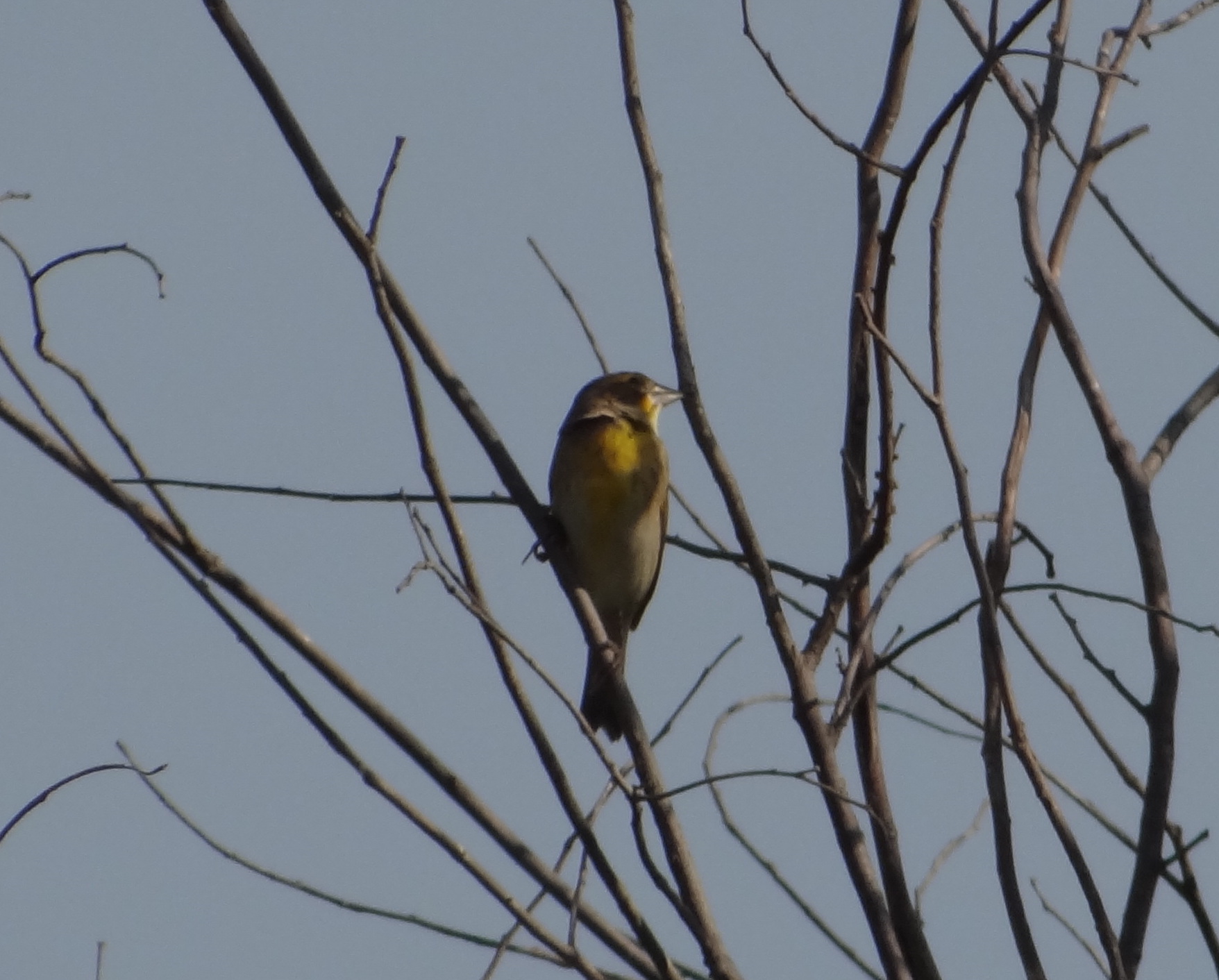
Dickcissel

Wednesday, August 5, 2020

Late Summer Birding

Birding is usually pretty slow for me in the summer. College Station and Houston love to crank up the humidity, and I for the longest time I never woke up early enough to take advantage of the prime birding hours. Now that I'm back in Dallas, armed with a much better sleep cycle and up against less humidity, I have been loving birding in the late summer. 
Scissor-tailed Flycatcher, Trammell Crow Park

My first stop on the tour was the Finegan Ranch in Mineola, which is private property owned by a high school friend's family. There is some serious birding potential out there, and I am convinced they've got something good birds like Swainson's Warbler. My first night out there I heard the strangest bird calling out while we were fishing by the pond. It was an unmistakeable Chuck-wills-widow! Lifer #424! I've heard the species in particular is struggling with massive habitat loss issues, but we heard multiple that night which is encouraging considering the owners will take great care of it. My alarm clock was actually a Yellow-billed Cuckoo, and on some trails on the property I would hear several more, in addition to Black-and-white Warblers and Indigo Buntings. I also saw massive woodpecker holes which indicate Pileated is present. I really can't wait to bird here more throughout the seasons and see what else is out there!

My next stop was on Saturday at the always reliable White Rock Lake spillway and fish hatchery. I'm ashamed to admit that it took me so long to realize it, but I only recently discovered the ponds and trails in the woods that I was really excited to explore. I started out heading to scope the spillway in hopes of getting some shorebirds. A nice surprise of 2 molting Black Terns flew overhead as I went up the hill. While the variety of shorebirds was limited, it was a great opportunity to work on telling apart Western and Semipalmated Sandpipers. Seeing them side by side made a massive difference, mostly seeing the differences in body shape and bill length.
Killdeer (L) with Semipalmated Sandpiper (bottom R) and Western Sandpiper (top R). Notice the Semipalmated being smaller, grayer, and having a short bill while the Western has browner scapulars.

The trails were pretty quiet, which I expected. I'm had great looks at Eastern Kingbird, which for some reason I seemed to not see as many of down on the coast. Ruby-throated Hummingbirds were common as were Tufted Titmice. The highlight was a full pond that was very secluded. I was able to sneak up on Green Herons and a White Ibis. White Ibis is normally something I admire at a relative distance, but seeing one so close reminding me of how stunning they are. They look like something you would find in the tropics with their bright red face and bill contrasted with the bright white plumage. I stood there for about 10 minutes just chillin with the birds until they eventually moved on. I would up with 34 species on the day, not bad for an August morning!
White Ibis

The final stop of the birding run was Trammell Crow Park with Matt Duross. A Roseate Spoonbill was being seen down at one of the bridges and the ponds were going to have other waders. Roseate Spoonbill is one of my favorite birds and they visit here as post-breeders. I always loved seeing along the coast, and I really miss seeing them as often as I used to. We got there pretty early to a busy pond. We had 2 spoonbills among other things waders. Pretty much every wader was seen, although I missed the Tricolored Heron that Matt saw. Shorebirds were pretty abundant, and I got plenty of county birds like Solitary Sandpiper and White-faced Ibis. An Upland Sandpiper had been calling at one point, and I really felt uneasy about counting it because I don't like heard only lifers that aren't an owl or nightjar. Luckily that wouldn't be an issue. Walking back to the car in the heat I was pretty much done birding, but a sandpiper with a short straight bill flew out of the grass and across the levee. UPLAND SANDPIPER! I am ashamed it took me this long to get an Upland Sandpiper, if you told me I would see a White Wagtail before one I would have laughed in your face.
Roseate Spoonbill, Trammell Crow Park

It looks like that's a wrap on my late summer birding, as I have a few weekend trips planned with friends, but it was a fantastic month with 2 lifers! Weather permitting I'll have a day to maybe get out to Wolf Springs to look for Swallow-tailed Kites and other shorebirds I'm missing. 

Fall will be starting off with a bang, though. We're going to Washington! I booked a flight to Seattle for Labor Day weekend to take a pelagic out of Westport and to camp at Mount Rainier National Park to look for White-tailed Ptarmigan and Gray-crowned Rosy-Finch. This will also be my first pelagic, so I am extremely pumped for that. I have about 50 lifers that I am gunning, which obviously I won't get all of, but it'll keep me extremely busy!

Tuesday, June 16, 2020

Migration in Dallas: The New Normal

Without a doubt moving to Dallas was the best possible thing I could have done. With that said, there are some things I was worried about when I left Houston. A ton of my college friends still live there and the food was outstanding, but my primary lamentation was leaving behind the incredible birding of the Upper Texas Coast. I was fortunate enough to get to experience Lafitte's Cove once this season, and after crushing it on the warblers I was afraid I would only get to experience the joys of migration when I make the drive to the coast. To quote Lee Corso, "not so fast my friend!" This "new normal" of Dallas migrations is actually quite nice.

There are many areas in Dallas to go for migration spectacles. Bob Woodruff Park, Village Creek Drying Beds, Wolf Springs Road, Moss Park, Trinity River Audubon Center, White Rock Lake, are only a few great places to visit. I won't focus on shorebird migration here because I didn't really experience it this year, but my brief jaunt to Wolf Springs Road in Ferris was OUTSTANDING! A major short cut my time short but there is abundant shorebird habitat and I got my lifer Clay-colored Sparrow! I'm really looking forward to late summer visits here later this year.
Yellow Warbler

Unfortunately the pandemic has left my favorite place to bird in Dallas proper, Trinity River Audubon Center, has remained closed until June 30. There was a silver lining, however. I spent tons of time at Harry Moss Park, which was a revelation. Harry Moss is a big park along White Rock Creek. There is a meadow that isn't mowed, although it has a few paths. Dickcissels are extremely vocal and Mississippi Kites can be seen soaring overhead. You can further walk through the woods and pick up a myriad of species. I didn't explore too much due to the mosquitos in the still woods but it was quite peaceful and I think it'll be very productive in winter.

The real highlight is the pecan grove that is a short walk from the parking lot. Migrant. City. Warblers and flycatchers were abundant. The highlights were Bay-breasted Warbler and Willow Flycatcher, a stunning Chestnut-sided Warbler, and a cooperative Yellow Warbler to name a few. The tall grass is home to Indigo Buntings and Vesper Sparrows (a lifer for me) and Yellow-billed Cuckoos and Great-crested Flycatcher's rule the tops of the trees. I had limited availability, but other birders were able to get Blackpoll and even a MacGillivray's Warbler.
Bay-breasted Warbler
Another new stop was Bob Woodruff Park in Plano. I only made one trip out there this year, but it was due to a lack of time, not lack of quality. There are a ton of trails that wind through the woods, as well as a creek that provides ample birding opportunities. My visit was short and not at the right time of day and I still had multiple species of warblers, including excellent looks at Black-throated Green, and a Summer Tanager. I need to improve my birding by ear when it comes to warblers, as they seem to call more up in Dallas than they did on the coast.

The last stop was a familiar one, but unfamiliar in the season: White Rock Lake. The spillway and fish hatchery offer up some great habitat for migrating songbirds if you can get off the main areas of the trail. I think the single best day my dad and I had was here. Along the edge of the woods we had a variety of migrants including Indigo Bunting, Swainson's Thrush, and Eastern Kingbird. I suspect there were even more in the woods, but the thick clouds of mosquitos drove us away. A strange call from in the woods lured me in, and that's when I learned a Wood Duck call! Around the lake we had a singing Warbling Vireo and Baltimore Oriole as well.
Wood Duck
Overall this migration exceeded expectations, and I didn't even make it out to every site. I missed Prairie Creek Park and Village Creek Drying Beds. The aforementioned Trinity River Audubon Center had been productive in the past, getting me Blackburnian Warbler in the right time of year, so who knows what else is to be found in the Trinity's vicinity.

Dallas exceeded my migration expectations, can't wait for the party to resume when shorebird migration starts up!
Yellow-crowned Night Heron

Ecuador Part 1

I am shocked this trip happened. When Sydney was born, I expected about 2 years of not doing a birding focused trip, but I have a very suppo...