Thursday, April 22, 2021

Golden-cheeked Warblers in Dinosaur Valley State Park


Most of my recent birding has been pretty local. I had an excellent experience with a Barred Owl at White Rock, but other than that it was the usual suspects. I leave this weekend on a much anticipated trip to all 3 national parks in south Florida, and in my excitement I had to get out and chase something. I was able to convince some friends, Alex Curry and Luke Curran to join me for a morning of looking for Golden-cheeked Warblers. 

Dinosaur Valley is one of  my favorite state parks, and it is criminally underrated. The hiking is spectacular and I consider Limestone Ridge and Denio Creek to be a top 5 hike in the state. There are also dinosaur tracks in the Paluxy River, which is also great to swim in. To top it all off Golden-cheeked Warblers nest there. I've seen these stunning birds before, but every year I have an itch to see them. They're the only bird that exclusively nests in Texas, and they're endangered. They're the perfect birds to go after around this time of year when you're antsy waiting on warbler migration to pick up.

Golden-cheeked Warbler

We arrived around 8:30 and it was way colder than I was hoping it would be, but while we waited for it to warm up we looked at the main track site in the river. The water was surprisingly not cold and we got clear views at tracks that were over 100 million years old! One dinosaur was hunting another when they left this tracks. We didn't have time for the ballroom site, but that is another must see.

We crossed the Pauluxy again and started our ascent up Limestone Ridge. The elevation is not significant, but it's interesting to see how the vegetation changes in about 100 feet. The lower elevations reminded Luke and I of the Chisos mountains where there is a lot of oak and denser vegetation. Once we got to the higher elevations it opened up a lot more, with Ashe Juniper being the dominant tree. This was the habitat we wanted to be in, as this is perfect for breeding GCWA. 

Northern Cardinal

Once we got into the habitat we were immediately greeted by a singing Black-and-white Warbler, which was extremely interesting until a Golden-cheeked erupted in song. While not tall, the trees were dense which prevented us from seeing it. We continued on, occasionally hearing more calling. As we rounded a turn near a "peak" we heard a loud Black-and-white, which we all stopped to look for. The area around us exploded with various bird calls. Blue-gray Gnatcatchers became visible and a Golden-cheeked started calling right in front of us. All we could see was the branches moving, and another one sang over our heads. As we scrambled to look it darted out right in front of us. Only Alex saw it, but he definitely got eyes on it.

Bird calls can be really tough to locate because the calls seem to echo off of rocks and trees. As we approached the overlook we heard another one loudly call, it was right on top of us. Alex had a hunch to go up the trail and he was right. The call got louder and we were temporarily distracted by a Black-chinned Hummingbird. But we committed a cardinal sin of birding: we completely lost interest in a hummingbird. We had good reason to, because a Golden-cheeked was singing right above us. 

Lark Sparrow

We had a total of at least 3 on the ridge, and the view of each one was better than a last. They were extremely active in the one tree that gave us the perfect view. They jumped around the exposed branches of an Ashe Juniper with the light behind us for about 20 minutes. Slack-jawed awe is probably the most accurate description of the feeling, and it was one of those unforgettable birding moments.

We didn't have many other species as we completed the last half of the hike, but that's to be expected. What this park lacks in diversity it makes up for in species quality. It was also nice to just enjoy a hike with friends on a beautiful spring day. Even if you aren't birding, Limestone Ridge, Denio Creek, and Black-capped Vireo trails are stunning, and you have to stop and periodically and enjoy the clear water beneath you. We finished our day in the quaint downtown Glen Rose where we dined on excellent burgers and pie at the Green Pickle and Pie Peddlers. 

The park and Glen Rose are a perfect day trip. Luke and Alex should definitely keep joining me on birding trips if they can deliver more birding magic. To say I'm excited for Florida would be a massive understatement.

Sunday, February 21, 2021

Sax Zim Bog

There have always been birds in my field guides that I immediately make my peace about never seeing. Most of these cases in my North American field guide usually are northern birds that don't make it very far south. Gray-headed Chickadees, for example, are only found in the Alaskan wilderness that require bush planes, backpacking, and unreliable weather. But it turns out, I had a chance to see some of these birds if I was willing to face a few challenges.
White-breasted Nuthatch

The place to see some of them is the Sax Zim Bog, a 300 square mile area of bog and boreal forest about an hour north of Duluth, Minnesota. While it hosts a myriad of neotropical migrants in the summer, the main draws arrive in the winter. This is the most accessible site to see some of the hardest to find birds in the lower 48, like Hoary Redpoll, Northern Hawk Owl, and Boreal Chickadee. While not range restricted, this is also considered one of the best places to see Great Gray Owl as well. You just have to be willing to brave potentially frigid temperatures.
Woessner Bog Walk

Frigid turned out to be an understatement. I planned my trip for President's Day weekend, which happened to be during a polar vortex hitting the area. Lows were projected around -20, but that number inched lower and lower as my trip approached. Much to the chagrin of my family, I still decided to go.

The thermostat read -40. The coldest temperature I'd experienced prior to this was 15 degrees when I was in high school. My knees and face hurt, but the Admiral Road feeders, my first stop after searching for Great Gray Owl earlier in the morning, soon made me forget that pain. In front of me was my first lifer of the trip. There was not one, but a flock of Pine Grosbeaks, one of my more sought after birds. I looked for this stunning pink bird in Maine, Alaska, and Washington with no luck in the past. This was one of the birds that provided the inspiration to begin out of state travel, so to see these in person was an incredibly rewarding experience, and the serene snow covered ground and bright green spruce painted a perfect backdrop. I would return to the feeders multiple times throughout the weekend, and the Black-capped Chickadees, Canada Jays, and woodpeckers of the Hairy and Downy variety would never get old.
Pine Grosbeak

After that I went to the visitor center on Owl Avenue. I heard that this was one of the best places to find Boreal Chickadee, the bird I wanted to see most (I came into the trip not expecting to see Great Gray or Northern Hawk Owl). I immediately had another lifer upon arriving- Evening Grosbeak! A massive flock was swarming the feeders, and it almost hurt me to continue on my way. The cold definitely hurt, but I have wanted to see an Evening Grosbeak for years and it felt wrong to look to look away, even though there were other birds that had to be admired.
Evening Grosbeak

Walking down Gray Jay Way to was one of the more scenic part of the trip. Temperatures had warmed up considerably to around -10, which makes a big difference, and the trail of packed snow was lined by snow covered spruce and tamarack trees. Even though I wasn't far from civilization I got the same rush I felt when I was in Boot Canyon in Big Bend, or when Anthony and I hiked Thorofare Ridge in Denali. The majesty of the American outdoors was on full display. My short walk ended at a collection of feeders where there was already a small group of people waiting for the chickadee to show up. 
Gray Jay Way. There has to be Boreal Chickadees in those trees!

According to Sibley, Boreal Chickadee is usually more secretive compared to other chickadees, and as a result they very rarely will go to bird feeders. Except in winter. So while they do breed in Minnesota you are way less likely to be seen in more...pleasant weather. I looked for them in Alaska without luck, so deep winter was my best bet. My fingers were quickly going numb, but after about 20 minutes we heard a call! Shortly after, a brown headed chickadee appeared- BOREAL CHICKADEE! The bird offered excellent looks for a few minutes, and the next day I was able to see it in the same spot at the suet feeder on Sunday.
Boreal Chickadee

Before leaving I saw that a Northern Hawk Owl was being seen off of CR 7. I raced down and started scanning the tops of spruce trees. Northern Hawk Owl is extremely rare in the lower 48 even in winter (Duluth is on the far southern end of their winter range), so the opportunity to see one should not be passed up. I find owls very hard to find, but this owl luckily wasn't too hard thanks in part to its diurnal nature. A weird spec at the top of a spruce tree far off the road gave it away, and even though the views and pics weren't great you could clearly tell it was a Norther Hawk Owl! Bird of the trip so far!
Northern Hawk Owl. Sniped from a distance.

With the afternoon winding down I walked Yellow-bellied Bog. The feeders were full of Common Redpolls, a stunning winter finch that I only briefly saw in Alaska. Desperately trying to find a mixed in Hoary, I was thankful for extended looks of an entire group! Yellow-bellied Bog was one of my favorite walks because of the trees were sunk in snow but their branches covered the trail. After the brief walk I headed back towards the Admiral Road feeders where I would spend the remaining hour of daylight, where there were more redpolls. I thought I had Hoary but after submitting it to people who know more than me it was determined to be Common. At sunset I drove up and down CR 7 checking every clearing for Great Gray Owl, and someone saw one at a great distance, and it was gone before anyone else got eyes on it.
The Common Redpoll that I really wanted to be a Hoary. There's too much streaking on the flank, though 

Sunday was more of the same so I won't go into too many details. The same birds that I saw the prior day were in the same places, although at Warren Woessner Bog I had Black-billed Magpie on a deer ribcage. Friends of Sax Zim Bog does this really cool thing where they have deer rib cages set up near the feeders, which draws in magpies, ermine, and sometimes pine martens. I've never seen that before, and it was such an interesting way to bring in other animals.
Canada Jay

The best part of my trip was in the last hour of birding. I'm terrible at owling, and I had given up on seeing the Great Gray Owl. Only 2 groups had reported sightings in the weekend I was there, and they weren't very good looks. Oh well, even without the Great Gray I saw incredible birds. But I still drove up and down CR 7, scanning every tree in every clearing. I planned to do this for about an hour and a half, and for the first 45 minutes or so I saw nothing as the sun sank lower.

But ahead I saw a group forming on the side of the road. There are only 2 reasons for a group like that: a tour or an owl. I pulled over behind them and walked up. A guy excitedly told me that an owl had been seen but people lost it. This was my only shot, so I started scanning. I was casually pointed to a Northern Shrike at the top of a tree, the person clearly didn't know that was a lifer for me. I was so pumped because I'd missed this plenty of times, but I didn't have time to take a picture because the crowd erupted. I turned around to see the source, and my jaw hit the icy asphalt on the road. 
Great Gray Owl, bird of the trip

Up against an orange sky clear of clouds was the silhouette of a Great Gray Owl. It looked like something out of a National Geographic magazine. Towering at over 2 feet tall, this the largest North American owl, and their gray body makes them resemble a ghost. Seeing pictures of one does not do it justice, especially when it swoops low across the ground. It was extremely cooperative and stayed near the road for an extended amount of time. I pretty much stayed until you could only faintly see it in the twilight. It was one of the best birding experiences of my life, and the subzero temperatures became and afterthought as we gaped at the owl. Numb fingers aren't an issue when you're staring at a Great Gray Owl. 

The Sax Zim Bog exceeded the expectations that were set as a birding Mecca. I got 7 new lifers, and each one was as outstanding as the last. The bog is a perfect way to spend a weekend birding, and you'll get to see some of most sought after birds in the country. The weather, while cold, is very manageable and should not be a deterrence. This place seems like an outstanding summer spot as well, I will for sure be coming back multiple times in multiple seasons! Between this and the Spotted Rail, the birding travels have been outstanding. Who knows what March will bring? 
Canada Jay and Pine Grosbeak

Evening Grosbeaks at Mary Lou's feeders

Monday, January 18, 2021

Chasing the Spotted Rail at Choke Canyon State Park

Let's rewind to December 29, 2020. I finally have an opportunity to chase the Spotted Rail at Choke Canyon State Park. But there was an issue, the weather was supposed to be awful. Do I risk it or do I stay put? A 5.5 hour drive in the dark and rain seemed like a bad idea, so I stayed in Dallas. And I am very thankful for that. I had a really bad feeling leading up to the trip, and my gut was right. It was cold and rainy all day, and driving home from work (at the same time I would have been on the road) I got a flat tire that I would not have wanted to deal with on a rural road at night.

Fast forward to January 16, 2021. I'm moved in to my condo, my car has new wheels, it's a long weekend, and the weather could not be better. Let's get on the road!

"Why?" - most non-birders when I tell them what I'm doing. "5.5 hours? For a bird? That doesn't seem worth it." Of course, they're incorrect with that statement. It isn't just a bird, this is a Spotted Rail we're talking about. An ABA code 5 rarity, this would be the rarest bird I've seen in North America (although strangely not the rarest bird to Texas with the White Wagtail being a first state record). This is the 4th ABA record of the bird and the 3rd Texas record, although the first chaseable record of this bird. The first two specimens were dead birds found in Pennsylvania and Brown County, TX and the third was a Houston area record that was turned into a wildlife rehabber and never seen again. 

Spotted Rail

Rails are an interesting family of birds. American Coots and Common and Purple Gallinules are related and are the most likely to be seen, but I have also had solid luck with Sora and Clapper Rail. They are notoriously hard to see due to their habitat and habits. They live in marshy areas and love to hide, so good luck seeing them. It's my understanding that the ABA allowed counting heard-only birds partially to stop people front tramping over habitat of Black and Yellow Rail. Little is known about them due to their elusive nature, but it is known that Veracruz, Mexico and Cuba are about as far north as the bird gets. But rails are known to wander hundreds of miles away from their normal range.

Long story short, the odds of another one turning up are very low, so you better better not waste the chance to see one. 

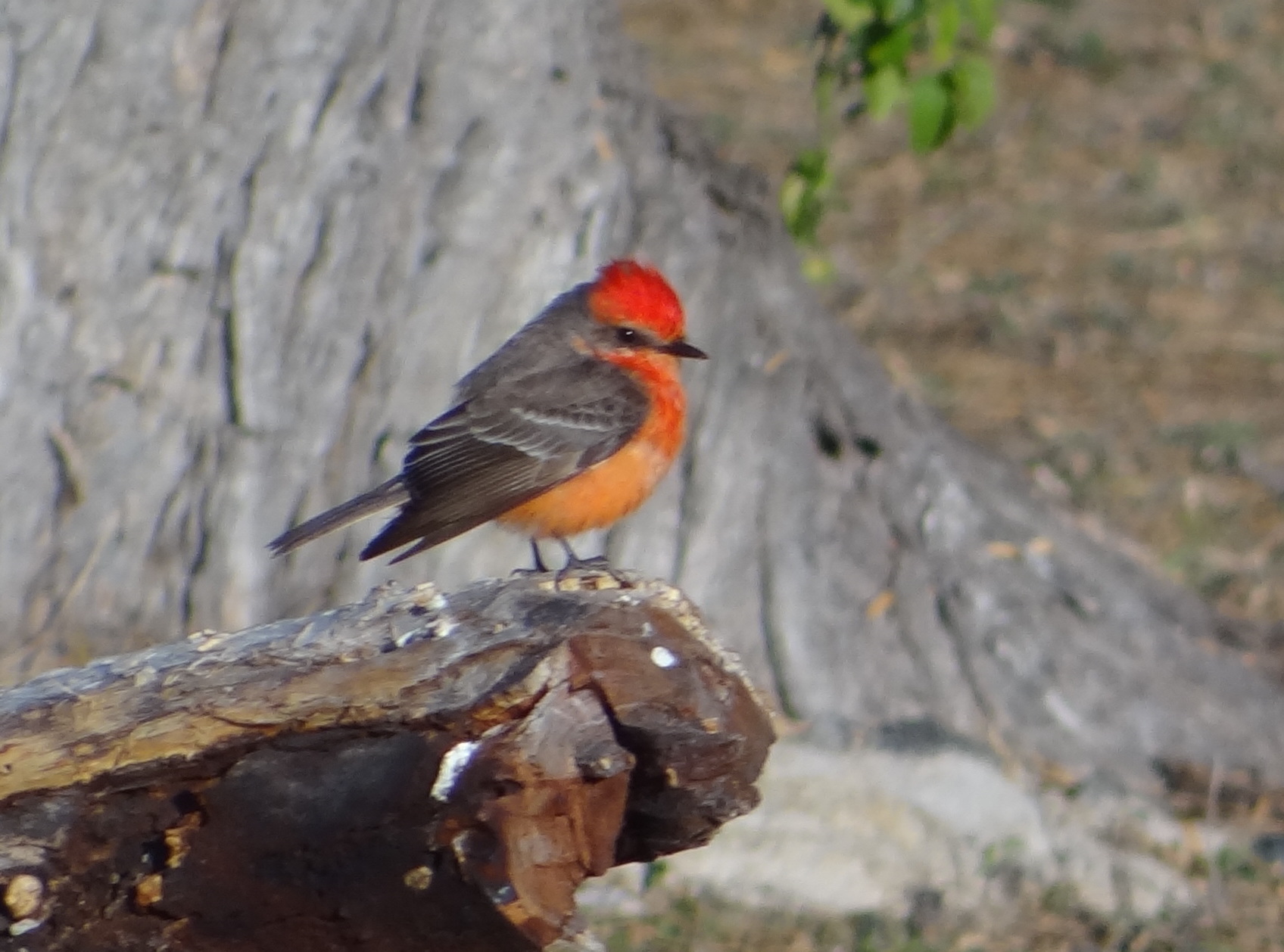
Vermillion Flycatcher

After a night of staying with friend of the blog Anthony, I woke up early to make the remaining 2.5 hour drive to Choke Canyon. The weather was perfect and I knew it was going to be a good day from the moment I entered the park. This is on the far north end of the range of south Texas specialty birds, so within seconds I had a Great Kiskadee and Long-billed Thrasher. Upon parking I had great looks at a Vermillion Flycatcher and Green Jays were squawking in the trees behind me. Let's do this.

Yellow-rumped Warbler

There wasn't much to do, within seconds of walking up I had views of the Spotted Rail running between clumps of cattails! Getting a picture was very difficult, as the rail was usually visible for just a few seconds at a time. Those few seconds were outstanding, though. Whoever found this bird deserves heaps of praise because it could be so hard to find. They walk very low to the ground, and we couldn't even see it move. But eventually we got excellent looks at it, and the light was perfect to allow for outstanding views with no shadows.

One of the few times it was cooperative

After an hour of admiring the bird it was time to look for others. Although I would not see them, Hook-billed Kite, Long-tailed Duck, Black-throated Gray Warbler, and Anna's Hummingbird had also been reported, as well as a host of other birds that I rarely get to see.

My walk down Hawk Alley was extremely productive. Audubon's Oriole and Verdin were highlights, but they didn't steal the show. That spot was deserved for Common Paraque, and this was the first time I saw one without having someone point it out! I'm cheating because I saw briefly in flight, but (shocker) I couldn't relocate it when it settled down. A calling Dickcissel was unusual and out of season. 

Common Paraque taken at Estero Llano Grade State Park

I returned to 75 Acre Lake to scan for the Long-tailed Duck and Hook-billed Kite, but neither materialized, although Sora and Cinnamon Teal were nice consolations. By now I was running out of time, and I still had about 6 hours between me and Dallas. I made one pass at the Black-throated Gray warbler spot and came up empty, but I did get an Olive Sparrow that was very cooperative.

Say's Phoebe

By now it was 1:00, I had to go. But I can safely say I will be back. Choke Canyon's Calliham unit is very small, but it packs an insane birding punch and rare birds frequently turn up here. I was there 4.5 hours and didn't even bird the whole park and I had 70 species. You better believe celebratory Czech Stop was consumed on my way home.

Tyler State Park and Rarity Chasing

 Mid-December wound up being full of great birding opportunities. This year has seen an irruption of finches as they disperse south due to low conifer seeds in northern forests. Evening Grosbeaks, Pinyon Jays, and even a Clark's Nutcracker have shown up in Texas, and birds like Mountain Bluebird, Pine Siskin, and Western Bluebird have spread out in greater numbers across the state. 

Another bird that has swarmed Texas is Purple Finch, and a rare wintering bird that is usually only found in east Texas and even then it is uncommon. This year they have been way more common, showing up farther south and farther west, including White Rock Lake. But Purple Finches being more common overlapped with another opportunity: Christina has never been camping as an adult and this was an opportunity to turn her into a camper and a birder! I also wanted to try for Brown-headed Nuthatch, #1 on my nemesis list now that I have Magnificent Frigatebird checked.

We started out on the Blackjack Trail, which had great sparrow habitat. White-throated Sparrow was abundant and we got great looks at Chipping and Field Sparrow as well. American Goldfinches were common as well. After quickly finishing the short trail we started Loop A, which took us through us through excellent pineywoods, which had to have Brown-headed Nuthatch, right?

White-throated Sparrow

Loop A is a 2.5 mile trail that winds through excellent forest that was very active. Cedar Waxwings were everywhere, as were Carolina Chickadees. I checked every Eastern Bluebird in hopes that I could get a Western, but no luck. Woodpeckers were also very active, and we got 5 species. My alarm clock in the morning was a loud Pileated Woodpecker, and Downy Woodpecker could be heard all down the trail. I never saw a Hairy, but they do get frequently reported there. We got a view of a Pine Warbler and a few vocalized which got us pretty excited, and an elusive Brown Creeper was climbing a tall Pine. 

I kept watching the trees for signs of Brown-headed Nuthatch, and I finally saw some movement! It was absolutely a nuthatch, and when I finally IDed it was...a White-breasted Nuthatch. We saw tons of them, but never their Brown-headed brethern. We would not see Purple Finch or Brown-headed Nuthatch, but there's no such thing as a bad day in the woods so it wasn't a big deal!

Our last trail was took us all around the lakeshore at around 2 miles. Due to the time and increased activity the birds were scarce in general, although along the dam there looks to be excellent vantage points to look for birds higher up in the trees. We did have Pied-billed Grebes and Ruddy Ducks on the lake, although there was not much else. Tyler State Park is an excellent blend of birding and hiking, and I will for sure be making a return visit.

Pied-billed Grebe

There was also major excitement surrounding local rarities. For those unaware by now I am fascinated by animal populations and what causes them to move around, whether that is wandering temporarily or range expansion and contraction. Jaguars in northern Mexico/southern Arizona and Ocelots in south Texas are especially interesting, but it spills over to birds as well (I highly recommend Rare Birds of North America by Steve Howell, it will fascinate even the most uninterested birder).

Anyways, a rare bird palooza has unfolded in the DFW area. I was really pumped to chase a Surf Scoter in Irving until I got a notification that a White-winged Scoter was present in Frisco. White-winged Scoter is a little rarer than Surf Scoter, and with a small amount of time to bird I had to prioritize WWSC. And then another notification, Great-blacked Gull was seen in Denton, and someone later found 2 Iceland Gulls. You can't turn that down, but I was really going to be cutting it close with the A&M game starting at 11.

The birding 2 minute drill began. 1st and 10 on the 20. Christian's Subaru ran an out route along 635 to the tollway with minimal traffic, solid 10 yard gain. The defense showed blitz and we got risky calling a draw play, but it resulted in a hasty gain, gashing the defense for a long run to Frisco. 

Things started looking a little dicey. I showed up to Phillips North Lake in a subdivision, expecting to see it on the small pond. After a quick scan, nothing but Lesser Scaup. Incomplete pass, second down. I hustled down to the main pond and looked across. Bufflehead and Greater Yellowlegs were cool finds, but not much. 3rd and 5. I rounded the smaller pond to see a larger duck in the flock of scaup. Somebody studied their birding film and knew this had potential. White wing patches were visible, WHITE-WINGED SCOTER! FIRST DOWN!

White-winged Scoter

Time was running out, and I called a comeback route as I headed southwest to Trinity Fork Park, where the Great Black-backed Gull had been spotted. I raced into the parking lot to find the gull had departed, but the two Iceland Gulls were there, as were a few Lesser Black-backed Gulls! I had potentially seen one at White Rock a few weeks prior, but I didn't count it because I wasn't certain. Now there was no doubt, the birds were massive but had dark shading around the eyes that separated them from the Herring Gulls around them. My last hope was the Railroad Street pond a half mile away.

4th and goal at the 5, make or break. GBBG is a TBRC review species, and this is the 63rd record in Texas, but it is almost exclusively found on the coast. This is the first DFW record, and only the fourth record of it not being found on the Texas coast, with 2 coming from Lake Meredith and one from Lake O' The Pines. You don't want to miss this one, and they are very hard to miss.

I pulled up to pond to find a few cars and scopes out. They told me it was on the pond, and it stuck out like a sore thumb. This gull is massive compared to other gulls, and it looked like a B-52 soaring over the water. We got it! Touchdown! After admiring for it a few minutes I had no time to spare, and I raced home to shower before making it to the game on time. 3 state birds and an Aggie win, it doesn't get any better than that!

Sunday, November 29, 2020

Puerto Rico

We've been birding all over the ABA area, but heading to distant lands to view other colorful birds has always been on the list. I can finally show people my pictures of birds and (hopefully) get actual interest. Let's face it, a tody looks way cooler than a sparrow, even if that sparrow is a rarity. Selecting Puerto Rico was pretty easy in a pandemic, but planning for it was not as easy. Puerto Rico has 17 species of endemic birds, and a host of other incredible birds spread across the island. If you really want to bird the island you need about 5 days of birding if conditions are perfect, which is obviously not going to be the case in the tropics. We had 3 days so we were obviously going to miss out on some areas. This time I had some company, Robert, an old friend from high school, was making his first Birding with Christian trip!

We arrived in San Juan on our first day in the afternoon with Ponce as our stop, about 2.5 hours away. Our first stop near Caguas was one of the only places to see Plain Pigeon on the island. We went to the baseball field to look up in the trees, only to find it closed due to the pandemic. We waited outside for pigeons to fly over, observing the first lifers of the trip. Greater Antillean Grackles were abundant, as were Scaly-naped Pigeons, and we had a Gray Kingbird as well. Doves did fly by, and in the moment I thought we had our Plain Pigeon. But I can't count it after looking at field guides. The views were so brief that I couldn't get the field marks to rule out other common doves. I started questioning whether or not there was white on the wings or not, and at that point you just have to accept that you're a terrible birder and you need to take the L. We only had about 30 minutes of daylight to bird so I wasn't kicking myself too much. On to Ponce!

Pearly-eyed Thrasher

Ponce was the closest city to our first real birding stop, Guanica State Forest. This dry forest on the southwest coast is home to many endemics, most notably the endangered Puerto Rican Nightjar. This is the best place in the world to see this species. Plenty of endemics can be found here as well. Remember how I said conditions had to be perfect? They weren't today. Rain was expected on and off, making our birding urgent. But the moments of sunshine made for it with intense moments of stellar birds.

Within a few minutes of driving in we had our first big find. Sitting in a tree was a Smooth-billed Ani! Anis are some of my favorite birds because they look like dinosaurs with the massive bills and uniform black colors. I have seen Groove-billeds in the RGV, but Smooth-billeds are very rarely found in the Everglades area of Florida. Within a few minutes a massive bird flew across the road and I slammed on the brakes, I instantly knew what we had. PUERTO RICAN LIZARD-CUCKOO! This was one of the birds I came here to see, and it did not disappoint. I saw enough of it to admire it for a little bit, but in typical cuckoo fashion it was very skittish and disappeared before we could get a photo. 

It started to rain once we got on the trail, but that didn't stop us from seeing some fantastic birds. A very cooperative Pearly-eyed Thrasher greeted us, and shortly afterwards we got our second endemic, Adelaide's Warbler. We would see plenty of the latter of each side of the trail. We also had a Puerto Rican Woodpecker, Bananaquit, and Puerto Rican Flycatcher. The star of the trail would be a Puerto Rican Tody. Todies were the birds that really got me into Caribbean birding, and while common, seeing one absolutely made the trip. 

Puerto Rican Tody

Bananaquits became way more abundant as we got higher up. This is like the Chickadee of Puerto Rico. They sound similar and are everywhere, but they never got old. Coming from the mainland a Bananaquit is stunning bird. Their name sounds exotic, they look exotic with their curved bill and black and yellow bodies, and the Bahamanian subspecies is a rare visitor to the Miami area. We had to have seen over 100 total on our trip and each one was as exciting as the last. Just before the rain started up again we also had Red-legged Thrush, Puerto Rican Bullfinch, and a female Black-faced Grassquit. By this time the rain turned into a torrential downpour and we left the camera and binoculars in the car to hike on.

Bananaquit were every but were hard to get moving through the foliage

Day 2 took us to Maricao State Forest, which was the spot I was most excited about. This was the best spot for 2 of my most sought after birds of the trip: Puerto Rican Spindalis and Antillean Euphonia. Getting here is a pain, and there aren't many trails outside of one at the 16.8 km marker. You have to go to Sabana Grande and then head towards Maricao. Google Maps took us the wrong way from San German, which led to an over hour long detour up treacherous mountain roads.

Due to our map error we got on the trail at 10:30. I was stressed, we missed prime birding hours. But those fears  evaporated when we head a bird that Robert compared to a jazz drummer. Deep in the foliage I could get a very clear of what it was. PUERTO RICAN SPINDALIS! Formerly called a stripe-headed tanager, a spindalis has long been on my list of sought after birds. Western Spindalis is another stunning and rare visitor to southern Florida, so whenever one shows I always consider catching a flight to chase it. But here one was 15 feet away from me!

Green Mango

The fun was only beginning, you can tell not many people travel this trail and it was extremely overgrown, coming up to our thighs. We paused at a hill and just listened, and in a few minutes the forest came alive. The first bird to come out made this 25 year old man squeal with delight. Antillean Euphonia, the best looking bird I've ever seen provided minutes of entertaining views out in the open. I was so slack-jawed that I almost missed another stunning bird. Robert, who knows nothing about bird identification but makes up for it with enthusiasm and great eyes, whisper yelled "hummingbird! Behind you!" I turned around and about fell over with shock. He found the endemic Green Mango! All of this is going on while we were ignoring a brilliant American Redstart. I'm stopping in Texas to see that bird, but in Puerto Rico it may as well have been a House Sparrow. Opportunities to see show many shades of blue, green, and yellow don't come around too often and need to be taken advantage of.

Antillean Euphonia

Eventually the birds moved on and we continued to a heavily shaded area that initially seemed quiet. We only saw one bird here, but it was one of the more sought after birds. A small black and white warbler was shifting in a bush, and came out to reveal itself, which caused me to about faint. Elfin-woods Warbler! This endemic bird was only discovered in 1971, and they are pretty hard to find due to their reclusive nature and the dense mountain forests in Puerto Rico. To have one out in the open was a serious treat, and it made the ensuing Carrasco Plant rash totally worth it. Our day wasn't quite over, and we hiked around Hacienda Juanita before eating lunch. We had just enough time, and it ended up being much needed. We got some of the better looks at Bananaquit we had, but a vibrant Puerto Rican Emerald stole the show. On our way out we had a Loggerhead Kingbird, which I am so glad we got a picture of because I thought it was the more common Gray Kingbird initially.

Lack of a dark mask and no notched tail makes it a Loggerhead Kingbird!

Our last day was spent at El Yunque National Forest, but almost no birding was done due to rain. We still saw Red-legged Thrush and Puerto Rican Tanager up close, and that was ok considering the quality of birding the last 2 days. It was nice to just hike and listen without looking for stuff. El Yunque does have great birding, it just wasn't on display for us, but the rain forest absolutely made up for the lack of birds. Cascading waterfalls behind dense tropical vegetation was a sight to see, and if anything the rain added to experience. Our hike up Mt Britton would have been packed with birds if it was drier, but instead we got to listen to the water rushing down the mountain. It was so peaceful!

El Yunque

Overall this was an outstanding birding trip, I ended up with 23 lifers to put my total up to 478. A good chunk of those 23 were also some of the most beautiful birds I've ever seen, so that made it even better. We would have seen more if we had more time, but we gave it all we had for the time we were there. If the rain had held off we would have for sure had Yellow-shouldered Blackbird, Puerto Rican Screech Owl, and Puerto Rican Nightjar. If we had a few more days we would have gotten Puerto Rican Parrot as well, but missing it gives me a perfect chance to come back. An extra day or 2 would have allowed us to hit Susua State Forest for Key West and Ruddy Quail Dove, Rio Abajo for the parrot, and Humacao for West Indian Whistling-duck, Caribbean Coot, and Antillean Crested Hummingbird. 

Magnificent Frigatebird

Despite our misses, I am so glad that we prioritized Maricao, Guanica, and El Yunque. Guanica and Maricao were perfect for birding and should be used to get the majority of the birds one would look for on the island. El Yunque is without a doubt the best hiking destination. I can't wait to get back and chase some more endemics!

Thursday, November 5, 2020

Everglades National Park


 The Everglades are one of the most iconic natural areas in the country. When people think of them they of a tropical swamp full of alligators and mosquitos, and you wouldn't be wrong to think that. But there is so much more to the Everglades. This is an incredibly unique area, especially when compared to the rest of the country. Located just north of the Tropic of Cancer, the Everglades are home to flora and fauna that cannot be found anywhere else in the United States. 

This is the only place in the world where alligators and crocodiles coexist. The Seminoles held out for ages here due to the inaccessibility of the area. And it's less than an hour's drive from the Miami suburbs. With the Columbus Day banking holiday it was a no brainer to make the trip here to chase some of the unique birds. 

American Crocodile

We arrived at the park late morning on Saturday morning at around 11:30. Not the optimal time for birds, but the scenery made up for it. The sea of grass stretched on for miles, and we frequently saw Great Egrets and Little Blue Herons shoot up to fly away from the road. There isn't a ton of land in the Everglades. It's pretty much a massive river flowing from Lake Okeechobee down to Florida Bay. This provides ample habitat for most of the waders found in the United States, which we saw plenty of. 
Florida Softshell Turtle

But there is also a mix of hammocks, or small islands of trees that elevate about the water to provide ample habitat for many other species of birds. Our first experience with one was very productive with a stunning male Black-throated Blue Warbler. Things really picked up at our second stop, Mahogany Hammock. A stunning Prairie Warbler was very cooperative, but it was not the best bird on the trail.

A larger bird moved in the trees above the trail, which was very odd. The trees seemed too dense for anything larger than a warbler to move, and by the time my eyes registered it was a bird it was gone. TJ, likely annoyed about having to look for a bird that was likely gone, pretended to be patient. Then the dark bird flew to an opening in the canopy that left it perfectly in the light. WHITE-CROWNED PIGEON! Some people will be surprised that I got hyped over a pigeon, but it's more than just a pigeon.

White-crowned Pigeon

It's no secret that I hate established exotics like Rock Pigeon, but this is a different bird. WCPI is a primarily Caribbean species that extends north enough to be in the Everglades.. They are very secretive and apparently impossible to photograph. And here it was, basking in the sun for perfect views.

Our next stop was Flamingo, where we walked around the beach in search of shorebirds. Highlights were a lifer Red Knot, and the best views I've ever had of Black Skimmer and Wilson's Plover. For someone who is absolute garbage at identifying shorebirds it was very helpful in getting Wilson's Plover down. We also stopped at the marina for one of the better nature experiences of the trip. This is probably the easiest place to see American Crocodiles in the United States, and we were really fortunate to see 2 of them. They are finally rebounded after nearly being extirpated in the 1970s. On the other side of the bay we got to see at least 10 West Indian Manatees frolicking in the water.

Wilson's Plovers

I could hardly sleep that night, as Sunday brought the search for the most sought after bird: Snail Kite. Another locally threatened species, Snail Kites are found throughout central and southern Florida. Finding them can be a bit of a challenge, as they depend on water levels to find their main source of food, the Apple Snail. Finding one would be hard, as you can't actually see them in the park. The best place is along Hwy 41 on the Miccosukee Reservation just across the street from Shark Valley. Your best bet is to just drive the highway and hope you see one above the tall grass. My four eyes were a real advantage in this situation, and within 5 minutes a black raptor was spotted. I slammed on the brakes and pulled over, and sure enough it was a Snail Kite! 

Frolicking Manatees, a highlight animal of the trip

I wish I had a romantic story about how amazing it was to watch this bird for 10 minutes, but the Florida humidity had other plans. Everything from my glasses, to camera, to binoculars fogged up once we got out of the car, just in time for the bird to decide that hanging around a guy who couldn't contain his excitement was too lame for him. He took off and flew out of site, but honestly I didn't care. I got my Snail Kite. We finished the morning with a 15 mile bike ride around Shark Valley, which offered incredible views and was probably my part of the park. Birding wise it was pretty uneventful. We had tons of Palm Warbler, which I always get excited for, and 2 Yellow-billed Cuckoos.

We woke up on Monday morning after going shark diving with a pretty flexible schedule. We decided to head to John Pennekamp Coral Reef State Park on Key Largo to potentially get some last birds. On our drive down we had tons of Bald Eagles and Osprey. The park is as small as it is impressive, and it's really small. It feels way more tropical than it did in the Everglades, which makes sense given how much farther south it is. There are a few short trails, and all appeared pretty birdy. The best bird was a Short-tailed Hawk flying overhead, but we also had White-crowned Pigeon and lifer Cape May Warbler right outside of the visitor center. We finished the trip out by kayaking through mangroves, which unfortunately meant I didn't have my camera on me when 3 Magnificent Frigatebirds circled overhead. It was stunning, these massive birds look even better in person, and it was great to finally soak in views of a nemesis bird.

Anhinga

Miami is an excellent birding destination, even though we didn't go at the best time of year. I'd really suggest February, as it is likely drier so you'll get more waders in the Everglades, while still getting good winter birds with the off chance of a wandering Caribbean vagrant. Our shark diving took up a ton of time which kept us from getting Florida Scrub Jay and likely a few others, but obviously that's something you have to do. Next stop: Puerto Rico!


Thursday, October 8, 2020

Southside Wastewater Treatment Plant

 Birders are a weird bunch. We got to places and do things that a "normal" person would never, like waking up before dawn in the winter, driving across the state and back in one day, and going to some wacky locations like a dump or water treatment plant in the name of seeing birds. In the past I have gone to a dump to (unsuccessfully) look for Tamaulipas Crows, and I've been to a few water treatment plants in my brief birding career. In fact, these plants can be amazing birding locations. The tanks can hold a variety of shorebirds and ducks, and the property usually sits on some forest as well. 

Southside Wastewater Treatment Plant is one of the best, if not the best place to bird in Dallas. It's a massive property that has a wide variety of habitats, which is evident by the whopping 261 species that have been reported there. Rare birds are seemingly reported weekly, and it is one of the few places in Dallas county where you can see Wood Stork, Prothonotary Warbler, Bald Eagle, and Crested Caracara. There is one con, and that is access. You can't access it unless you gain permission, but that list is usually updated quarterly. 

No identification necessary

I finally got access starting September 1, but Washington and a major exam for work kept me indoors until last Saturday. Even then, I had to officiate a wedding that afternoon so I couldn't stay long. Matt Duross gave me a tour of the property, which he said is 15 square miles. I had a good omen at the beginning with Pileated Woodpeckers flying overhead, a county bird for me. We started out on some tanks just by the administration building that were full of shorebirds. Peeps were everywhere and we got excellent side by side looks at Greater and Lesser Yellowlegs. A Red-necked Phalarope had been seen here for a week, which would have been a Texas bird, but it was not to be found. Oh well, I saw them in Washington and at the clip rare birds show up here I'll likely get another crack at one next spring.

We continued to a field that was full of White and White-faced Ibises, more than I've ever seen. As we drove on we got excellent looks at Northern Harrier and a few Red-tailed Hawks, but our biggest prize was a pair of Crested Caracaras, possibly the only place in Dallas to see them. I have not seen them in a while, and they looked stunning in the clear sky. 

Crested Caracara

We went and looked at some empty tanks that were full of swallows, which are extremely hard to ID when they are flying in swarms. These tanks were just on the edge of the property, which borders a hunting and fishing club that offers no access. Matt said he has seen Wood Storks, very scare in Dallas County, flying over in season. I wish I had been here a few weeks prior! We drove along the levee past the nesting spot for Prothonotary Warblers on our way to the main event of the morning.

Bald Eagles don't need an introduction. But a lot of people have never seen an eagle, Bald or Golden, and underestimate their size. I've seen them up close in Maine and I've watching them soar along the Kenai River in Alaska during the salmon run and it is absolutely breathtaking. Most recently I saw one at Cullinan Park in Sugar Land as a speck in the sky. Seeing one is supposed to be a special occasion for me. But to see one in Dallas was something I thought to be very rare. I was wrong. There is a nest at Southside, and they are almost always there. You can also see them at John Bunker Sands, but to my knowledge those are the only 2 places one can expect to find them.

Anhinga

We ended up seeing not one, but two Bald Eagles sitting on power lines that allowed for extended views. We also had an Anhinga on the pond when we stopped to look at them, another county bird. We didn't spend a ton of time because my introductory tour was still not over. Our last stop was a massive pond in the center of the property. There were tons of pelicans and ducks, including Ring-necked, a county bird for me. We had a curious family of Black-bellied Whistling-Ducks with ducklings, which seems to be super late in the year for them. Matt got eyes on a Bank Swallow, which is a fantastic find. He pointed it out to me just in time to get a good look at it, and then a Tree Swallow flew into view. I was beyond pumped, as Bank Swallow is a Texas bird for me. The last big find as we left was an American Avocet, a county bird.

Ring-necked Ducks and American Coots

I saw all of the plant, but didn't have time to explore it in depth. And yet I still saw 47 species, which is probably double what I was expecting. It'll only get better as migration progresses, and I can't wait to get back when I have more time and don't have to rush home to officiate a wedding!

Ecuador Part 2: Mindo

Sorry for the delay on this. I know you, dear reader, were sitting on pins and needles waiting on this. I took my last CFA exam and then wen...