Monday, December 2, 2019

Rio Grande Valley Day 3: Salineno

The day started pretty foggy. I had plans to hit up Santa Ana NWR and Edinburg Scenic Wetlands. Santa Ana is considered the crown jewel of the National Wildlife Refuge system. Unfortunately I didn't have cash and they don't take credit cards. I had to call an audible, and I decided to switch my plans for the next 2 days. I was going to drive 80 miles west to Salineno. I wanted to get Morelet's Seedeater and it was the only place I could get my lifer Audubon's Oriole. I made the drive and it ended up being the perfect decision.

The weather was incredible. The sun burned off the clouds and the landscape became much more similar to the hill country. The preserve was not fully operational when I went, but one of the park hosts was in the process of setting everything up, but he did have the feeders up. This is one of the best places to bird. You can get up close to many RGV specialties like White-tipped Dove, Plain Chachalaca, and Olive Sparrow. I sat and chatted with the host about his adventures in the Chiricahuas while I waited on the Audubon's Oriole to show. Spolier: it didn't.
View from the Rio Grande. Mexico is on the other side.
I decided to try my luck with the seedeaters. You can walk along the Rio Grande to look for them in cane. This is one of a handful of places they can be found. Really they can only be seen in Del Rio and Salineno, but they have been found in Laredo and Eagle Pass. They used to be seen with Brown Jays at Salineno before supposedly leaving, but now they're being seen again. I've seen them once along the river, and I knew just where to look again.

The river is really scenic, and it's trippy seeing a foreign country 40 yards away. I couldn't find one to save my life. I saw small birds flying across the river, but I had no luck getting eyes on them. I did have Blue-gray Gnatcatcher, Vermillion Flycatcher, and even a Gray Hawk! I had one last option, and with some minor bushwhacking and being really stealthy I got one! A small, brown female was skulking around 10 feet from me. Success!
Vermillion Flycatcher
I returned in the heat to the preserve to see if anything would show up. After just a few minutes not one, but 2 Audubon's Orioles appeared! I got incredible looks at them, and it was completely worth the driving I did. I made a stop to look for Black-tailed Gnatcatcher, but no dice. I didn't care, I got the 2 biggest birds of the trip!
Audubon's Oriole

Sunday, November 24, 2019

Rio Grande Valley Day 2: Mission

Day 2 of the RGV extravaganza took me to the Mission to visit one of my favorite spots in Texas, Bentsen-Rio Grande Valley State Park. It's a huge park with a hawk watch tower that I hoped to catch some migrating hawks and maybe a Hook-billed Kite if I was lucky. After lunch I planned to stop by the National Butterfly Center.
Altamira Oriole
Bentsen is one the premier birding spots in not only the state, but also the country. Although there is no access to it, it does touch the Rio Grande and you can actually see Mexico from the tower. The size and age of the park has made it a fantastic place to spot rarities. Mega rarities like Stygian and Mottled Owl, Collared Forest Falcon, Masked Tityra, Aztec Thrush, Mexican Violetear, Jabiru, and Northern Jacana are just a few of the many insane birds you can find here.
White-tipped Dove
I didn't have a rarity of this level, but within 10 minutes I had my own find that had the park buzzing. I got in a mixed flock just near the gate that was full of the usual Nashville and Orange-crowned Warblers, but I got my bins on something that looked way different. No, GOLDEN-WINGED WARBLER! Another rare late migrant that I think was one of only a handful of park records. I was hyped over the lifer, and although rare in the park they are much more common an hour east on South Padre Island where they cross the gulf.

I think this park is the biggest in the valley and it is full of trails. Estero Llano Grande is a great birding spot, but this is a great hiking spot. They do really well in making you feel like you're in the wilderness, despite being a miles away from civilization. They also have a tram that helps getting to all the sights quickly.
Great Kiskadee
The blinds here are very productive. I was getting mixed flocks all over the place of usual migrants and the abundant Black-crested Titmice. The most impressive part was the hawkwatch tower. Kettles of Turkey Vultures in the thousands were soaring overhead. This was a spectacle. I was pretty late for the Broad-winged and Swainson's Hawks kettles and I was told what I saw was nothing compared to 2 weeks prior but I was still stunned. I did get a few Swainson's, but the Altamira Orioles stole the show. On a cloudy day their bright orange bodies stick out, and it's their jaw dropping beauty that had me hooked when I first saw them. I had also never seen so many swallows 

By this point I was starving so I began the 1.5 mile trek back to the car. Just when I thought Bentsen had run out of birds it gave me one last surprise in a stunning Gray Hawk that gave me the best looks of one I'd ever seen. 
Gray Hawk
After a fantastic lunch at Jack in the Box I made my final stop at the National Butterfly Center. I really wanted get Audubon's Oriole and there was one seen a few days prior just south of the levee. 

It was a little drizzly when I got there so unfortunately I didn't get access south of the levee, but I did get to walk through the grounds. This is another good stop for rarities. Yellow-green Vireo, Roadside Hawk, and Rufous-backed Robin have all been seen in the past. RGV specialties were everywhere, especially Altamira Oriole, which weren't as numerous as I expected this trip. Let me tell you, though, I thought this place was dope. I don't know a lick about butterflies but I want to learn more now after going there. It was shocking to see so many different kinds of them and they all were brightly colored. And there clouds of them. It was unreal. Before the next trip I'll have to find a field guide and go back.
Long-billed Thrasher
The last bit of evening was spent in an unlikely area: a Best Buy parking lot. Green Parakeets are one of 2 native species of parakeets in Texas, but sadly the Carolina Parakeet, the other native species, went extinct in 1918. There is considerable debate about where these birds come from. Some say escaped pets, which has merit considering the array of non-native parrots that inhabit the valley. However, I have read about them being seen in the 1800s in Texas, and the population supposedly boomed starting in the 1980s in wake of increased deforestation in northern Mexico. 

There is a lot of interesting (and sad) stuff going on in the border regions for birds. Mexico is destroying a ton of habitat, but fortunately for birds they can fly pretty far pretty quickly. This has pushed them to expand their ranges. Green Parakeets were always native to Texas, but the numbers boomed not from escaped pets, but from colonizers. Apparently there was a freeze in the 80s as well which killed palms and created perfect nesting sites for the parakeets.
Green Parakeets
This isn't unprecedented either. The edge of the neotropical zone is in the Rio Grande Valley, which explains why Green Jays, Great Kiskadees, and so many other RGV specialties are only found in the valley. As a result a lot of ranges on the fringe of the zone are contracting and expanding. Until recently you could find Brown Jays at Salineno, Tamaulipas Crows at the Brownsville Dump, and Hook-billed Kites weren't as rare as they are now. But all of those species have contracted their range south of the Rio Grande. All of these appear to be natural, and there have been cases of species starting to become way more common in the valley as well. Clay-colored Thrush is still listed as a Code 3 rarity in the ABA area, although 10x as many of them as I did Altamira Oriole. Morelet's Seedeater also used to be present at Salineno/Chapeno, then disappeared, then reappeared. Brown Jays are supposedly seen pretty frequently 25 miles south of the border. I suspect both Green Parakeets and Red-crowned Parrots, another debated but probably native bird, have gone through similar and expansions. These trends are particularly exciting when looking at eBird data in northern Mexico. Less than 100 miles away (and maybe closer given how eBird is not super common abroad) some stunning birds like Bare-throated Tiger Heron, Blue Mockingbird, Crescent-chested Warbler, and many others are seen with ease. Maybe we'll see some new species start to expand across the Rio Grande in the coming years. 

Sorry, I am way too fascinated with border birds, but the Green Parakeet roost at 10th and Trenton in McAllen is automatic. I rolled the windows and drove into area and heard a raucous chatter above my head. Dozens, if not hundreds were flying over to roost. The landed on power lines, trees, and the local Best Buy. Can't beat that, and just in time, too. I drove back to the hotel to watch the only birds I hate more than anything, the Philadelphia Eagles, get blown out by my beloved Cowboys.

Wednesday, November 13, 2019

Rio Grande Valley Day 1: Weslaco

I have been craving a long birding trip for months. Originally the plan was to go to Guadalupe Mountains National Park, but unfortunately plans fell through. I would have had to go alone, and that's not real safe in the cold mountains of West Texas. But there was one place I wanted to go that is always birdy: the Rio Grande Valley. It would be a 3.5 day trip. Day 1 was at Estero Llano Grande State Park and Frontera Audubon Center.
The abundant Green Jay is one of the most stunning birds in Texas
Estero Llano Grande is my personal favorite places in the state to bird. It's probably the most diverse place habitat wise and you'll get most Rio Grande Valley specialties. I set out at about 8:00 and was immediately rewarded. The pond in front of the visitors center is full of waterfowl and shorebirds. There are a few ponds throughout the park that are full of birds. Black-bellied Whistling Duck is abundant, but mixed in were plenty of Fulvous, a lifer for me. Mottled Duck, Blue-winged Teal, and Cinnamon Teal were also present. A walk along the ridge brought in tons of various swallows migrating and White-tailed Kites, which are pretty reliable in the right place.
Black-bellied Whistling-Duck (L) next to a Fulvous Whistling-Duck (R)
The area is also fantastic for migrants this time of year. A mixed flock of warblers brought in Nashville, Magnolia, Black-thoated Green, Black-and-White, Tennessee, Northern Parula, and even an American Redstart! The blind in the tropical area also had both Kingbirds, Curve-billed and Long-billed Thrasher, Bewick's Wren, and Olive Sparrow.
Clay-colored Thrush used to be very rare in the RGV but they have become extremely common over the years.

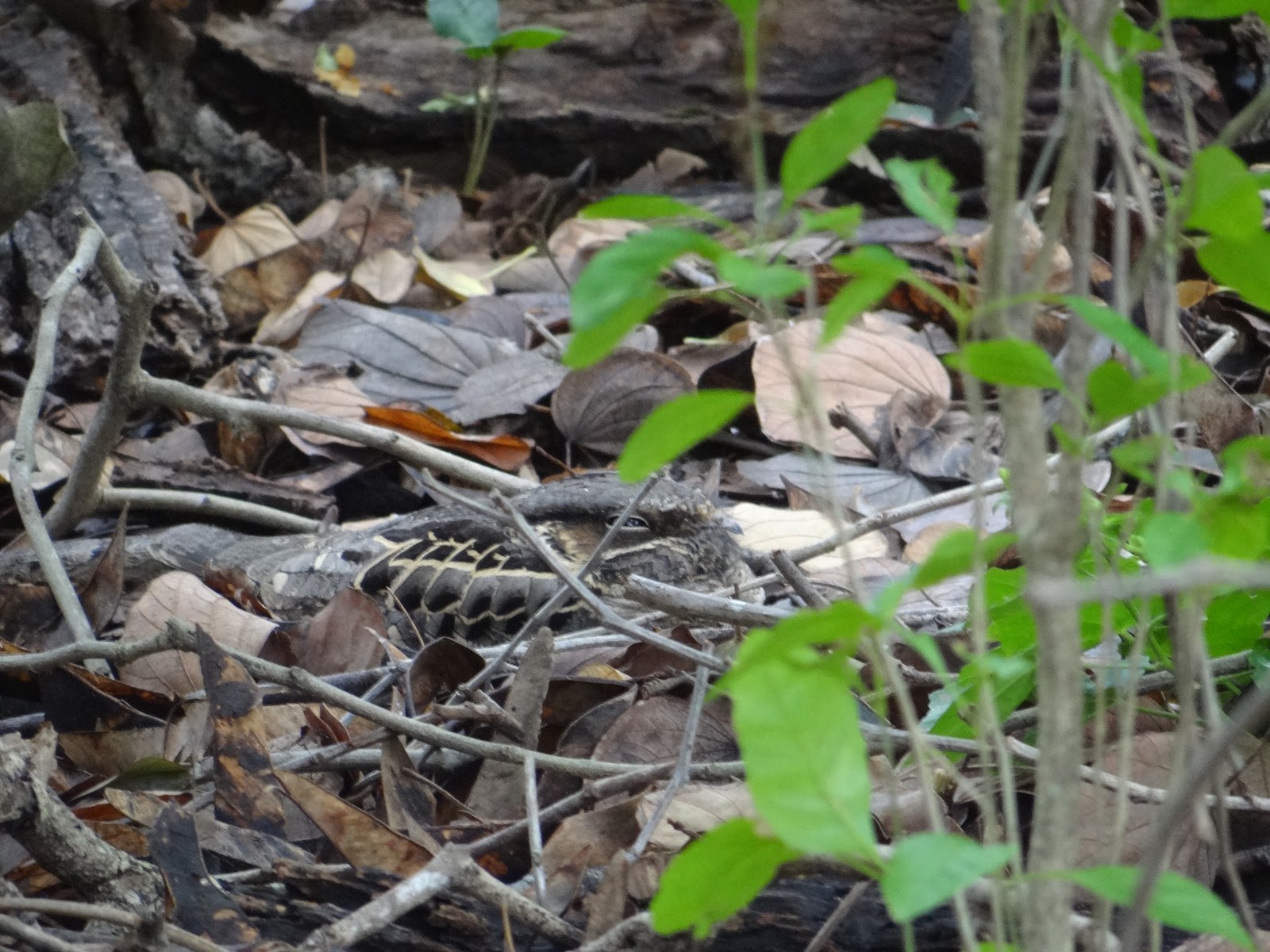
The highlight of the day was arguably the hardest bird to find in the valley. They are pretty common, but extremely elusive because they blend in with the dirt and shadows. Common Paraque is impossible to see if you don't know where to look, and then it's almost pure luck. And pure luck is what I had. At the first stop I made I scoured the ground and could not see a thing. Then I took a step and jumped out of my skin. I nearly stepped on one! I only saw a quick gray flash before it settled down and I couldn't see a thing. Colima Warbler may be the biggest physical challenge in the state, but Common Paraque is the hardest to see even when it's right in front of you.
Can you see it? It's a Common Paraque

By the time I left for lunch I picked up 75 species in 4 hours! We're definitely in the neotropical zone! Next stop, Frontera Audubon.

Frontera is right down the street. It's habitat is pretty much the same all around, but it looked like a great place to spend the afternoon. It did not disappoint. The thicket is Tamaulipan Thornscrub, perfect for Rio Grande Valley specialties. It's also just a really peaceful place that is great for an afternoon walk and it's really calming. Pretty much all RGV specialties from Estero Llano Grande were present, but Clay-colored Thrush was extremely common, and Buff-bellied Hummingbirds got right up in my face. The large hummingbirds are a captivating bright green. Great Kiskadees and Plain Chachalacas were very cooperative, and the feeding stations and pond benches get you close to the birds. I came before it gets really busy, the winter Texans were still migrating and they normally stock the feeders, but I can tell that when it's poppin the birds are out there in full force.
Black-crested Titmouse
The perfect end to the day came at one of those ponds. I was beat, and I decided to check out this one pond before I left. One of the best pieces of birding advice I was given was "birds are tired when it's hot in the afternoon. They're like us, they want to chill with a cool glass of water." The pond was somewhat birdy with migrants, and I thought I saw a wren bouncing around near the water, a little out of character for a wren to be on the water's edge. But it was something better than a wren. The tail bobbing that is similar to a wren's was actually a LIFER NORTHERN WATERTHRUSH! An insane and clutch find, I didn't think I had a chance to see one to close out the year. What a perfect way to end the day.
Plain Chachalaca

Saturday, September 28, 2019

Fall Birding in Galveston County

This is the time of year when our breeding birds begin their migration south for the winter. While not as big as spring migration, there are lots of shorebirds, flycatchers, and warblers moving through. Some birds are just about to leave their summer homes on the UTC as well, and I wanted to snag them before they departed. Fortunately I don't have to be up at the crack of dawn to go find them. I get off of at work at 12:30 on Fridays, so the last two were spent exploring the east end of Galveston County.

My first stop was the Texas City Dike, and 4 mile long tiny peninsula that extends into Galveston Bay. Unfortunately I lost my wallet the day before and didn't have the cash to pay the entrance fee that I didn't know about. Oh well, onward to Galveston! 

My nemesis bird has been American Oystercatcher for the last year and a half. It's not a hard bird to see, but it has eluded me despite me spending tons of time in perfect habitat. It looked automatic on East Beach in Galveston. I decided to head there, because Magnificent Frigatebird is seen often in Galveston Bay. 
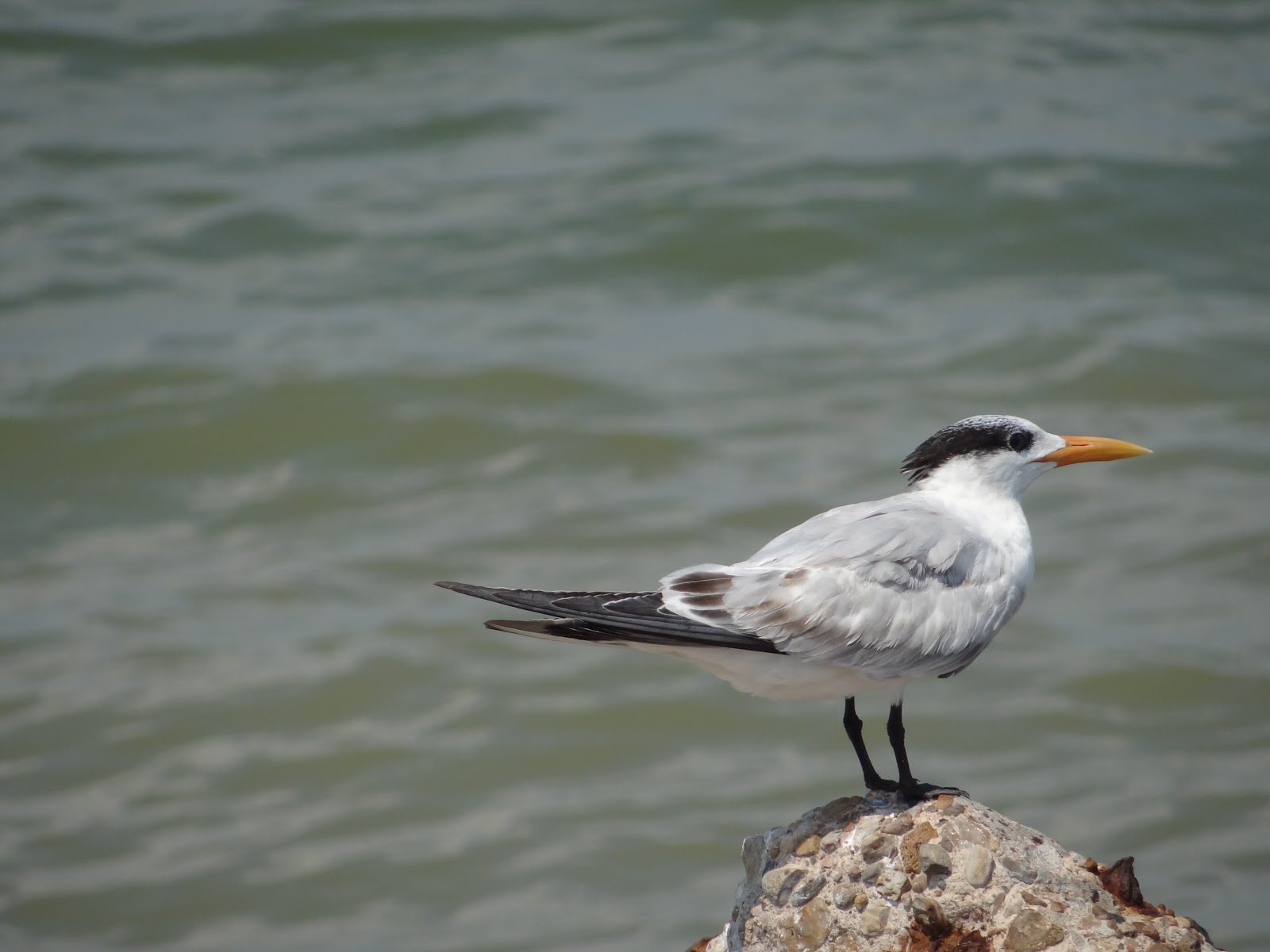
Royal Tern
I set up my scope on Boedekker Road and got to work. A great surprise was Marbled Godwit, a bird that I used to not be able to find to save my life. I saw it for the first time over Christmas, and it was a bird that I had just not considered. Black-necked Stilts were everywhere as usual, and the abundant bird of the day was Royal Tern, a target of mine. As I scoped down the shore I got great looks at Black-bellied Plover and Black Skimmer! I had really wanted to get Black Skimmer, it's a beautiful bird and awesome to watch feed, but I don't get to see them often. Overall Boedekker Road packs a lot of punch for a small area. Alas, there was no Magnificent Frigatebird or American Oystercatcher.
Willets are everywhere in Galveston
The last stop of the day was Lafitte's Cove. Early migration brought Canada Warbler and Yellow-bellied Flycatcher, both were birds I had chalked up as misses. Canada Warbler is a pretty good find on the UTC as well, but I didn't hold my breath. Empids are also extremely tough to ID, especially if you don't know their calls. Luckily someone studied up on them, and I've done some improving when it comes to IDing them.
Black-bellied Whistling-duck Ducklings
Lafitte's Cove was silent and I was the only one there on a late afternoon day. The trees weren't the vibrant green and the sidewalks weren't packed with excited birders like they are in the spring. But there were still birds, although not as many of them. A silent Brown Thrasher was the only thing I noticed before I starting to hear and see movement. Least Flycatcher appeared first, followed by Yellow Warbler, Black-and-white Warbler, Worm-eating Warbler, and Olive-sided Flycatcher. It was an unexpected, but welcome flock. I continued to inch along, getting Baltimore Oriole and Eastern Wood-pewee as well. The highlight was an unidentifiable empid. Then it let out its call. YELLOW-BELLIED FLYCATCHER! Big find. No Canada Warbler, but YBFL was worth the drive by itself.
Black-and-White Warbler
The next Friday, this time with cash, I ventured to the Texas City Dike, eager to finally snag some birds that I could not seem to find. Least Tern was an urgent one. They are not expected to last to October. This was also probably my last shot at Magnificent Frigatebird, and the resident but seemingly invisible American Oystercatcher was supposed to be there, too. The first 10 minutes were incredibly productive, as I picked up a lot of needed birds at the first stop. Least Tern was abundant, Ruddy Turnstone was walking around. Driving down towards the end of the 5 mile ish dike is really productive. Gulls and Terns gather at the beach near the end and are very cooperative. Laughing Gull is obviously everywhere, as were Brown Pelican, Royal Tern, and Black Skimmer.
Laughing Gull and Least Terns
The end of the dike offered the best scoping looks. I am PUMPED to get out here in the winter and scope for some ducks and Northern Gannets. The tip offers almost 360 degree water views for a few miles, and a scope on a clear day can be very productive. While it isn't open ocean it should have calm water that will make birding much easier in the shielded bay.
Black Skimmer
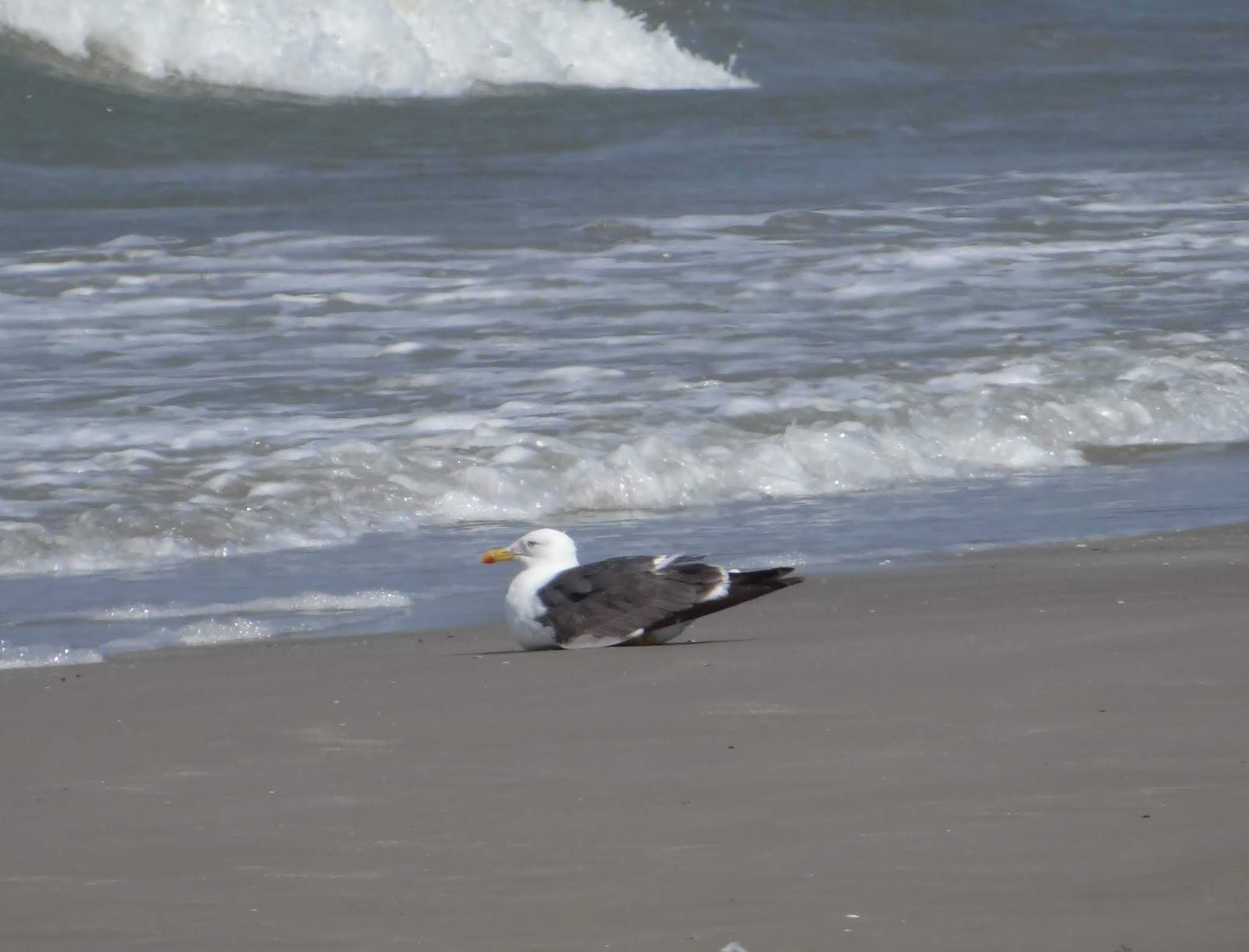
The tip also got me good looks along the beach. In a large flock of birds I at first thought that I saw another Black Skimmer with a bright red bill, but this was much too tall. I couldn't believe my eyes. American Oystercatcher! I looked in awe at such a beautiful bird. As I worked my way back down the dike I stopped for better pictures, and there were 2 more! It was an American Oystercatcher-palooza! There was one last surprise waiting for me. I looked hard for a Lesser Black-backed Gull with no luck. Luckily they are relatively easy to ID with their aptly named black back. I slammed on the brakes about halfway down the dike on my way out. One Herring Gull looked a little too dark to me. I snapped a pic, and the helpful Texbirders confirmed my suspicion of LBBG.
American Oystercatcher
I can't wait to get back later this fall and hunt down some rare gulls or Palm Warblers in Galveston this winter!
Lesser Black-backed Gull

Sunday, August 25, 2019

Brazoria National Wildlife Refuge

The brutal heat of the summer has kept me restricted to mostly indoor activities. I love birding more than most people, but a heat index of 100+ is too much. Temps cooled a little bit in the last week and I have some serious birding fever (more on that in a bit). Rain or shine, scorching heat or a blizzard, I was going birding. But where to go? The two options were Brazoria NWR or the Texas City Dike. Both had great birding options, but in the end Brazoria won. With football season quickly approaching I wanted to get the longer of the two drives out of the way, plus I could go for the soon to be departing Wood Storks and Least Bitterns. The Magnificent Frigatebirds will have to wait.
I see them all the time and I'm still not used to seeing alligators. I never saw them in Dallas growing up and I'll never get sick of seeing them.
I left a little late and arrived to the refuge around 9:00. I forgot how humid the Texas coast can get. But a good omen arrived. A Black Tern flew overhead, marking the beginning of a fantastic birding day. Black-bellied Whistling-ducks were calling, bullfrogs were croaking, and an assortment of wading birds were flying overhead. This was what I had been missing for so long. I walked down the Big Slough trail for a little bit, only to turn around due to insanely high grass and a close encounter with an unknown species of snake. I did get Red-bellied Woodpecker and an immature female Common Yellowthroat, which I otherwise would not have seen.
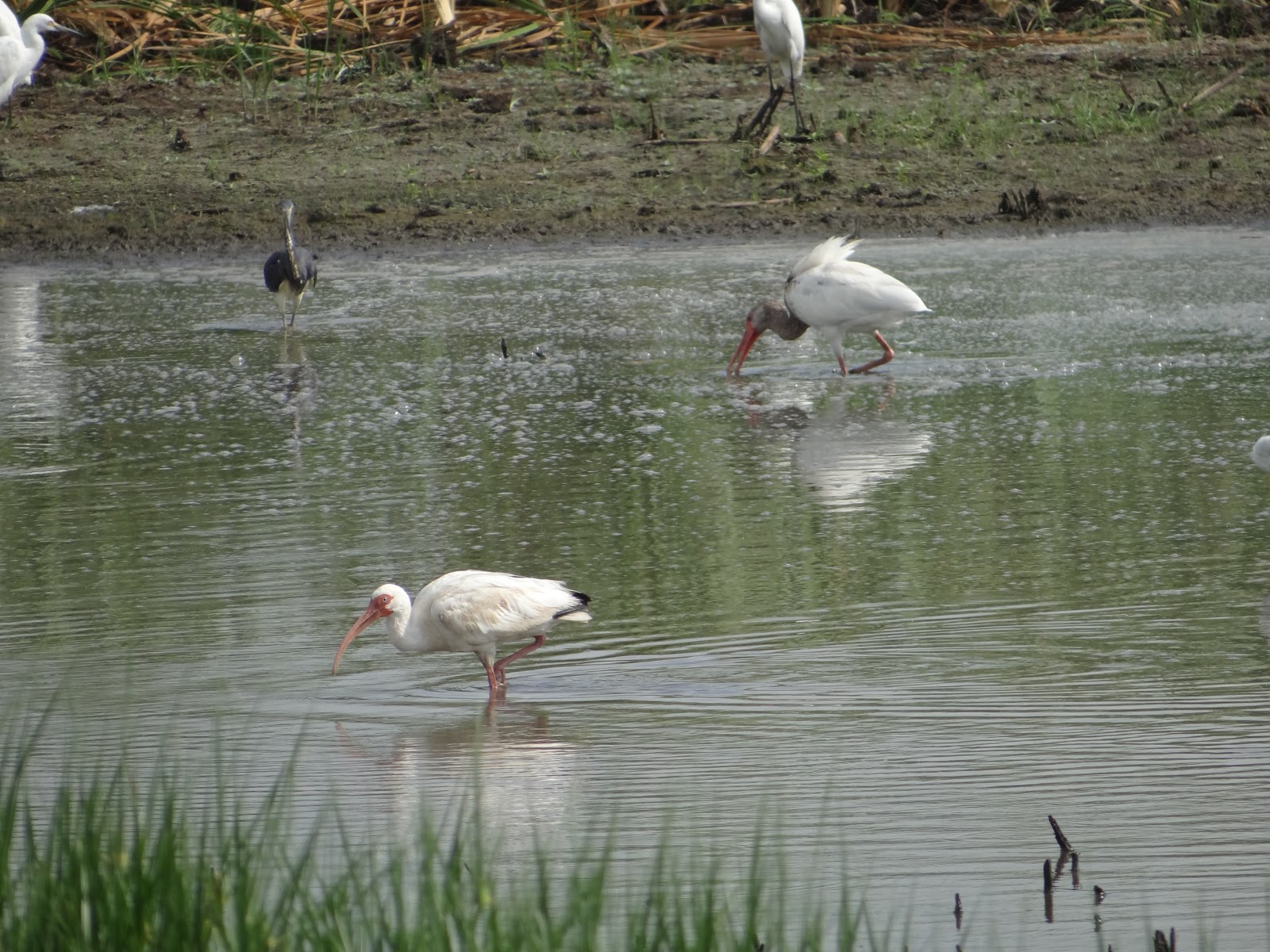
White Ibis
My three goal birds for the day were Wood Stork, Least Bittern, and Black Tern in that order. I chatted with a fellow birder and he said he had seen them all week, except for today. Funny how that always seems to happen. Normally I try to walk the auto tour at refuges, but the Brazoria trail is perfect for driving and stopping to get out. 

My first pond stop would keep me for about an hour. Tons of waders were out, and migrating shorebirds were refueling. Mottled Ducks swam around, probably annoyed at all the company. I got my scope out and starting scanning the waders, which I had seriously been slacking on this year. I started checking them off quickly. Little Blue Heron, Tricolored Heron, Green Heron, Wood Stork, White Ib- WOOD STORK?! Towering above everything else was a Wood Stork, and for a brief moment I stopped sweating, stopped being insanely hot, and I soaked it in. Wood Stork is not a lifer for me, but I only saw one as it flew off in the distance. This was close, still, and the great looks it offered made me appreciate it that much more.
Wood Stork in the middle with Roseate Spoonbills and a White-faced Ibis
Feeling pretty good I moved on to the shorebirds, the bane of my existence. I can't ID them to save my life, especially when they aren't in breeding plumage anymore. I got "The Shorebird Guide" and it's been a ton of help, but it's insane how difficult it is to get a good ID. They are all kinds of sizes, different shades, and bill length is hard to determine when you don't have the other species to compare (looking at you, dowitchers and yellowlegs). Luckily I got incredible views so I was able to get some pictures that would allow me to ID at my apartment. 
Took this at Brazos Bend last year, but there were plenty of Anhingas at Brazoria
As I scoped the shorebirds I saw something lurking in the reeds. It wasn't a gator, those were everywhere and not shy at all, and it was too big to be a rail. I quickly ruled out Green Heron as well. That left one thing: Least Bittern! I nailed all my target birds, everything else at this point was gravy. And there was still some gravy left.

I continued on to the next pond, a massive one that got me really up close to the birds that didn't seem to mind me at all. This is the best part about Brazoria. Much like Brazos Bend State Park, you get really close to the birds you want to see. And it just so happens that waders in my experience tend to be way more comfortable around people, so you get to to really appreciate the pink Roseate Spoonbill, the sleek Little Blue Heron, and the matted Tricolored Herons all at once. But what really added to today was the eye popping Black-necked Stilts and the alligators that slowly swam through the crowd of birds. I even got see a gator catching what looked like a massive catfish. With shorebird migration in full swing there were birds everywhere. I was going to get a lot of practice with IDing them.
Lesser Yellowlegs with a Western Sandpiper in the back
Western Sandpipers and Least Sandpipers were abundant. I also got a few Semipalmated Sandpipers. Short and Long-billed Dowitchers were all over the place as well. A flock of American Avocets chased around invisible fish through the water as well. But the star of the show was an unexpected one. Wilson's Phalaropes were dancing and spinning in circles in the pond! While certainly not rare at all, I hadn't seen them pop up when I was doing my research before setting out. I'll take it! I had to turn around pretty quickly because a storm was coming in hot. I left at the perfect time, as I left the refuge rain started falling HARD. 
Wilson's Phalaropes
The rest of today has been a breeze. Birding has this calming effect on me and I can't wait to get back again. Part of that excitement comes from an incredible morning of 46 species, including about 14 year birds. The only real miss of the day was Gull-billed Tern, and while I may have to work for that one I should be able to easily get the other misses: Least Tern, Reddish Egret, and Fulvous Whistling-duck, which is quickly becoming a nemesis bird. 
White Ibis, White-faced Ibis, Greater Yellowlegs, Tricolored Heron, and what I think is a Snowy Egret and Boat-tailed Grackle

I'm sitting at 237 year birds now, and that number should grow very quickly. I should clean up the Houston area's summer birds in two weeks at the Texas City Dike where I'll hopefully get my nemesis American Oystercatcher, Magnificent Frigatebird, Reddish Egret, Black Skimmer, and Least Tern. 

But the real thing to get hyped about is coming in October. It looks like Anthony and I are going to Guadalupe Mountains and Carlsbad Caverns. You know what that means. We're gonna do The Bowl, where we'll literally be birding the top of Texas. Who knows what we'll get. I'm holding out hope for a Lewis's Woodpecker or Hermit Warbler, but even getting what should be the easy Pygmy Nuthatch or Sage Thrasher has me all sorts of excited.

I'm really just happy that the weather is cooling down and birding/football is back.

Saturday, July 6, 2019

Alaska Part 4: Seward to Anchorage

We had an exhausting week. It was amazing, but we were so tired from going all day every day. We planned on working our way up to Anchorage from Seward by stopping a few places on the way to try to pick up some more species. A mega rare Falcated Duck was being seen at Potter Marsh, so that was our primary goal. Everything else was extra, and we didn't want to waste time.

Outside of Falcated Duck, there were a few other species of note. Arctic Tern was one we hadn't seen yet, Trumpeter Swan, Aleutian Tern, Pine Grosbeak, Red Crossbill, and Common Loon. eBird reports for some places in Alaska are VERY hard to come by, and they lack a lot of info. In hindsight I would have put a little more effort into today, but we were tired and really at our limits. There are tons of really good hikes right off the highway, but it's hard to gauge which ones are good for both the sights and the birds. Plus we were looking for strolls, not high elevation climbs.

But the eBird reports did give us a few stops. First stop was Tern Lake. As we drove we saw a flash of red cross the road. I really think it was a Pine Grosbeak. Like 95% sure. But since I'm not 100% I couldn't count it. Pine Grosbeak is a bird I've really wanted to get, but they're fairly hard to get. Part of it is they are so far north even in winter.
Common Merganser
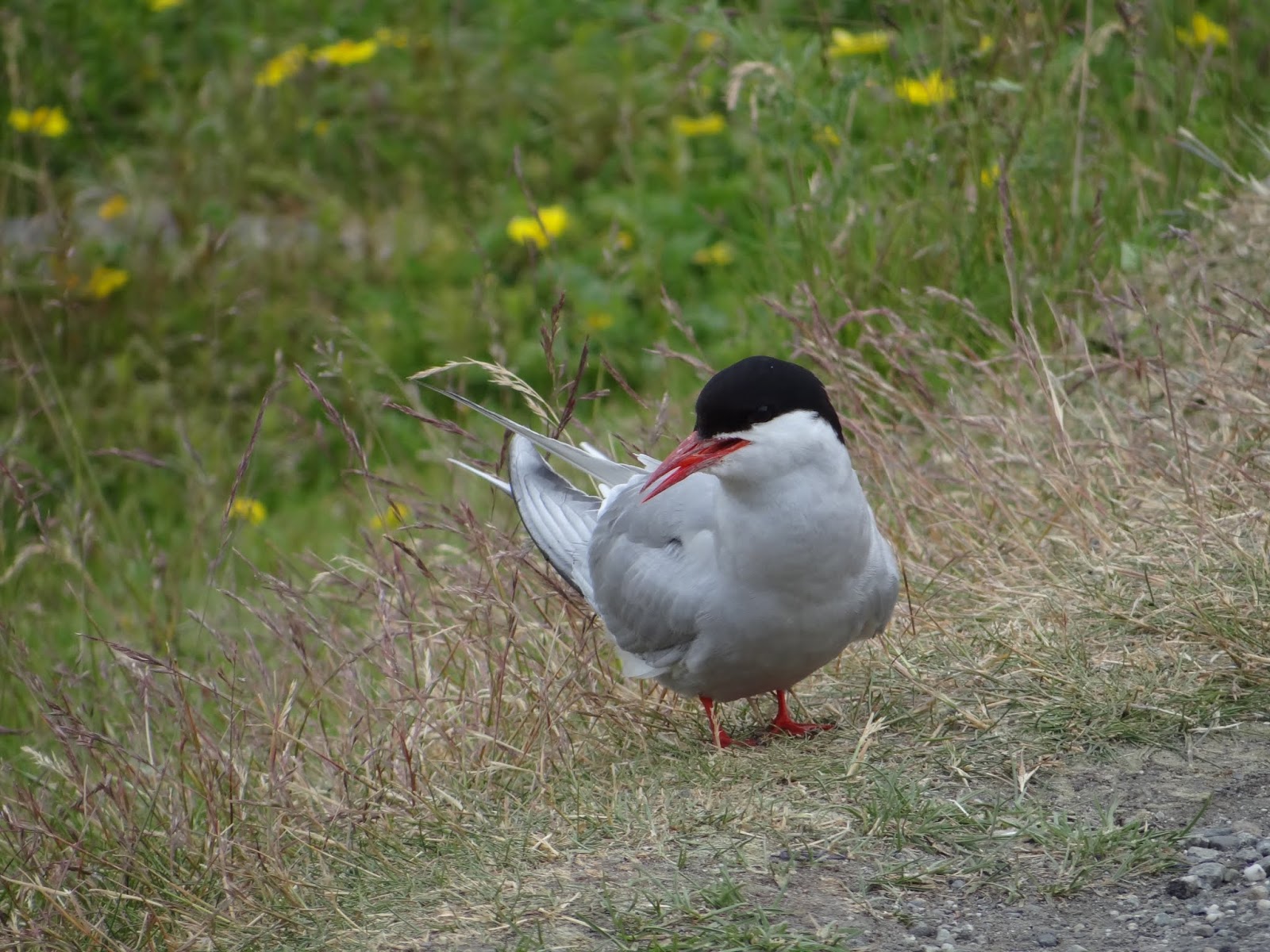
We arrived at Tern Lake to birders being about, a really good sign. Arctic Terns were flying overhead, a lifer that I was really pumped to get. Any bird with the name arctic or boreal is going to get my attention because to a Texan it sounds exotic. Arctic Terns are actually really common on the west coast, but we don't get them in Texas at all. A pair of Trumpeter Swans paddled silently way to the back of the lake, and Common Loons in their beautiful breeding plumage could also be seen. It sure beats their drab winter plumage that we see down south. We also had a lifer Varied Thrush and great looks at Black-legged Kittiwake. This was a pretty productive 20 minutes.

This is when I asked a question that I wished I never asked. I asked a local birder if Aleutian Terns had been seen. He said "no, but about an hour west of here in Soldotna I had them at Kenai NWR earlier this morning." I had to make a tough decision. We had an hour to spare, but that would be one less hour to look for Falcated Duck. I stuck to the plan and we continued north. I wish I had gone west.
Red-necked Grebe
Our next stop was Tenderfoot Campground, a USFS campground a little ways up the road. Pine Grosbeak was the goal. But Pine Grosbeak was nowhere to be found. We did get Lincoln's Sparrow, a bird already on the year list, and that was about it. I hoped for a possible American Dipper in the stream but no luck. We quickly walked back to the car to keep moving, but a duck caught my eye in the lake. It was for sure a merganser, but what kind? It looked Red-breasted, but Red-breasted doesn't have the white patch on the wing. That only left one other: COMMON MERGANSER! This was a very unexpected lifer but a welcome one. As we drove back down the road we flushed another colorful bird, but in the bad light we missed an ID. It could've been another Pine Grosbeak. I was really disappointed, but through the brush around the river we got a consolation prize from the birding gods. Goldeneyes were down there, but which ones? There was only one male, and it had a crescent white patch instead of a circular one. Boom, BARROW'S GOLDENEYE! What turned into a disappointing location ended up get nabbing 2 lifers, one unexpected and one I had given up on.
Barrow's Goldeneye. Females are on the left, and unfortunately the male's crescent shaped white spot on the bill is being covered by the leaf. Common Goldeneye is an uncommon winter visitor to Texas, but Barrow's stay way north.
After lunch we made our last stop at Potter Marsh, an outstanding birding location on the outskirts of Anchorage. Lots of shorebirds and waterfowl migrate through or stop at this marsh, right against the Cook Inlet. A Code 5 ABA rarity, Falcated Duck, had been reported for about a month. It was definitely out there. I wasn't really in a rush as the directions were pretty accurate. Unfortunately we missed one critical piece of information: the bird was inactive in the afternoons. Given our departure from Seward we were guaranteed to get there in the afternoon. Our hope was to get the duck and head out, stopping at other spots before our flight to Fairbanks.
We arrived to a ton of birders, but no duck. We didn't see it, and it was pretty disappointing. But, like the Great Black Hawk in Portland last winter, the Falcated Duck was a gravy bird. It happened to be there, and we didn't make any plans centered around it. We would have stopped at Potter Marsh regardless, so I didn't get down about it. There were still a lot of great birds out, including an Arctic Tern that swooped down and showed off its popular aggression when you get too close to a hidden nest. We also got to compare Greater and Lesser Scaup, the Greater Scaup being a lifer, and Cackling vs. Canada Goose. I got a breeding plumage Red-necked Grebe and a lifer Rusty Blackbird as well. But the real highlight was a lifer Red-necked Phalarope. We had 2 fly-bys, allowing me to get another very unexpected lifer. We didn't have time to go to some ponds by the airport, but it was fine because we got Pacific Loon at Kenai Fjords.
Arctic Tern
We flew back to Fairbanks for a quick night before our flight our flight departed for Houston. I'd like to offer a few final thoughts regarding our Alaska experience.

1. We got some amazing birds. The highlights were definitely Arctic Warbler, Kittlitz's Murrelet, Parakeet Auklet, and Pacific Loon.

2. Whatever you do, visit Denali. It is the crown jewel of our country. But it is not a great birding destination. There are no specialty birds and every bird can be found in more accessible places. But the mammals and scenery are the most stunning things you can see. Everyone should go at least once.

3. We missed some really good birds. Boreal Chickadee is a stunning miss that I thought would be easy, but we also missed Red Crossbill, Pine Grosbeak, Falcated Duck, Aleutian Tern, Red-throated Loon, and Thick-billed Murre. A lot of why we missed them because of number...

4. There is too much to do in Alaska. We ran ourselves ragged in a week, but we didn't go fishing or kayaking. As a result we also didn't have time to chase some of the birds we missed. An extra 2 days would have probably gotten us all of the Kenai Peninsula birds including Falcated Duck and we may have been able to snag a Northern Wheatear somewhere in Denali. We did so much, and we didn't even scratch the surface.

5. This was a life-changing trip. The beauty is astounding. The animals are near mythical. I came back with my mind refreshed and my stresses gone. I'm trying to figure out a lot of things in life at the moment and this was important for removing any stresses. That's what birding fever and untouched scenery will do for you. I now understand why people like Steve Jobs will go meditate in remote places. Anthony deserves a huge shoutout for being the perfect travel buddy and a very tolerant birding partner/photographer. It was actually depressing to get back to Houston because all I wanted to do was be back on that mountain looking down on the pristine land.

With 222 species down this year, where should I go next?
Cackling Geese look similar to Canada Geese but they have a shorter bill, head, and neck. They are also overall much smaller.


Thursday, July 4, 2019

Alaska Part 3: Seward and Kenai Fjords

Leaving Denali was bittersweet. Without a doubt it is my favorite national park that I've been to, although Big Bend is a very close second, so it was tough to leave. The physical part of our trip was over, and our second leg was a flight to Anchorage and drive to Seward for a Kenai Fjords glacier cruise. This was a little more familiar territory for me because I have been to Seward once before, but that was back when I was just getting into the whole birding/naturalist lifestyle.

After an afternoon of canoeing in Fairbanks, which yielded Yellow Warbler, Alder Flycatcher, Violet-green Swallow, and Bank Swallow, we flew to Anchorage. We got in very late, and after a super late dinner we started our 2 hour drive south along probably the most beautiful drive in America.

We left the bustling (292,000 people) city of Anchorage behind as we meandered our way down the Turnagain Arm of the Cook Inlet. Having just finished a book about Captain James Cook I felt like I was traveling through history because Cook actually explored and mapped the inlet on his last voyage when he looked for the Northwest Passage. It was honestly a trial to pay attention to the road. Waterfalls cascaded down on the side of the road and stunning snow capped peaks towered over a temperate rainforest. This landscape was vastly different than Fairbanks and Denali. We arrived at 1:30 AM and had to wake up less than 6 hours later, but it was again tough to sleep because we knew our world was about to get rocked.

You know you're in for a treat when the day begins with Harlequin Ducks

Anthony made a mistake letting me be in charge of picking the glacier cruise. I chose the longest one possible, a 9 hour, 120 journey. We would embark across the Gulf of Alaska to Northwestern Fjord to try to see whales, sea lions, and of course, incredible birds. The main target was Kittlitz's Murrelet, a rare and declining seabird that loves to be near tidewater glaciers. This small bird would be dwarfed in a vast fjord. Little is known about it, but it listed as "Near Threatened" by the ICUN and between 5-10% of the population was killed during the Exxon Valdez oil spill. But of course there were plenty of other good birds to see like Tufted and Horned Puffin, Rhinoceros Auklet, Parakeet Auklet, and many more.

We made our way into Resurrection Bay at 8:30 and were immediately captivated. Glaucous-winged and Mew Gulls flew overhead while Harlequin Ducks swam along the rocks. A lone Bald Eagle eyed the mouth of the river waiting in hopes of a salmon meal. But the star of the show was the sea otter. We saw many curious otters relaxing in the near freezing water.
Lounging in 50 degree water, casual
Rain started to fall, which normally would be bad on a trip, but it made it more of an adventure. The boat rocked in the waves as we made our way to the Gulf of Alaska. Horned and Tufted Puffins sat at the exit of Resurrection Bay as if to warn us that we were about to get into trouble. But the good omen of a lifer Pigeon Guillemot beckoned just into the gulf, convincing us that it was worth the risk.
Pigeon Guillemot
Seasickness was an epidemic on board. Many people were leaning over the sides vomiting as we crossed into some pretty rough waters, and Anthony started to feel bad. Slowly the numbers on the bow dwindled as the drizzle continued and as the boat heaved in the waves. But I think I discovered the cure for seasickness: Birding Fever. I was front and center on the bow (that had maybe 3 people on it by now, and 1 remained because he was so sick he couldn't move). Binoculars in one had and the other on the icy rail had me feeling like a pirate on the high seas, looking for my avian treasure. And it was there. Common Murres (and definitely a Thick-billed Murre was mixed in but I can't count) mixed with both puffin species to provide many bad attempts to ID distant birds. Believe it or not, it's near impossible to ID distant sea birds in rolling waves, one handed, while your surface is unstable. I held out hope for Ancient Murrelet, a really hard to find species, but it wasn't happening.

But Mother Nature smiled on my attempt, and our boat was promptly rewarded by a small pod of Humpback Whales extremely close to the boat, offering fantastic looks. Unfortunately we were at the roughest water we would see, so we had to skedaddle to calmer waters.
We were absurdly close to these giants
We entered Northwestern Fjord and its calm waters, much to the relief of everyone on board. It was beyond cold outside, but we had entered the area that offered our best shot at Kittlitz's Murrelet. How that bird survives with icebergs floating in the water is a mystery to me. We inched closer and closer to Northwestern Glacier without any in sight, but we did tons of Black-legged Kittiwakes, another lifer. There were also hundreds of Harbor Seals watching us float by, probably wondering what these mammals with such little blubber were doing near a glacier.
Harbor Seals at Northwestern Fjord
The majesty of the fjord was overpowering. The only noise that could be heard was the calving glacier. Waterfalls trickled down and the water was a gorgeous shade of light blue from the melted ice. Our hour long stop produced little birds of note, but it did give us the sense of adventure that James Cook had to have felt when he explored the surrounding area.
The fjord itself was still and there were no waves at all

I started to get nervous as we headed back. Birders actually worked the cruise company that we were with, and all eyes were on the water for a pint sized brown bird. But telling it apart from a Marbled Murrelet is tough. You can see the eye on the Kittlitz very well, but not as much on the Marbled because there is a dark patch around its eye. There are also white stripes on the edge of the tail that give it away.

Our cruise zig zagged through the fjord, and I once again represented 1/3 of the bow members, each of us looking in difference directions. I was nervous, remember how my old article on all of the dips I've had? This would be a tough one to miss given the remoteness of the bird.
Kittlitz's Murrelets

Then we heard a shout. One had popped up right by the boat before flying off, but I missed the identifying stripes. It wouldn't matter in the end, because 2 more came into view a few minutes later. The skittish birds flew off and there were the white stripes! I'm sure a lot of the non-birders on the boat were shaking their heads at some dude in a Texas flag fanny pack jumping around excitedly on the bow, and I would bet Anthony tried to hide his association with me. In total we would see about a dozen of them, and in a picture I took we even got a Marbled!
Marbled Murrelet. Notice the dark patch around the eye.
We continued out into the Gulf of Alaska where a steady rain was falling, but of course I was out on the bow. Rhinoceros Auklet, another bird that I was a little nervous about. Looming on the horizon was one of the places I was most excited to see: the Chiswell Islands. The Chiswells are a seabird rookery where a lot of seabirds were breeding. And a rookery in breeding season makes for some stellar birding.

A cacophony of noise greeted us. Black-legged Kittiwakes covered the rocky islands while Tufted and Horned Puffins looked down on us. Common Murres were everywhere, but again a Thick-billed could not be found. But a large flock of small seabirds flew overhead. This was a bird we had not yet seen, and it's call gave it away. PARAKEET AUKLET! By this point birds were flying everywhere. Steller's Sea Lions lounged on rocks and we even got a breaching Humpback Whale! We hoped for a Red-Faced Cormorant, but we could only safely identify a Pelagic Cormorant.
Parakeet Auklets
This was where another surreal moment of the trip happened. We were in the middle of picturesque islands while birds that people dream of hovered above us. We were miles offshore and getting soaked while we struggled to identify the birds around us. This was an adventure, and it was an almost intoxicating feeling.
The low clouds really added to the scenery
We started our way back Seward, making an extended stop for a very active Humpback, as well as stops at waterfalls and a cove called God's Pocket, one of the best sights I have ever seen. I cannot recommend Kenai Fjords enough. Even on a day of "bad" weather it is absolutely stunning. It's places like this that remind us how important it is to protect and appreciate the national parks that we have.


Ecuador Part 1

I am shocked this trip happened. When Sydney was born, I expected about 2 years of not doing a birding focused trip, but I have a very suppo...