Wednesday, November 14, 2018

Big Moves

American White Pelican
It's been a while since I last got out and birded, but this weekend I got a surprise chance to go to Dallas and do a little bit of birding.

In between my last post I picked up a whopping 2 birds on the year, a Tricolored Heron on my way driving back from the A&M-Auburn and Sandhill Cranes while driving to Disney World in Florida.

I decided to brave the freezing weather this weekend while up in Dallas and I headed off to White Rock Lake. A Red-breasted Merganser had been seen by the spillway, but unfortunately it was not there. There was a large raft of various waterbirds, but I could not tell find the duck in question.


Franklin's Gulls at the White Rock spillway


There was not much to note, but I did get Franklin's Gull for number 251 on the year! The gulls are still coming in, and I'm sure the Arctic blast that we got pushed plenty of them down further. I'm sure there was a Herring Gull out there, but unfortunately I'm terrible with gulls. I did get a scope that arrived once I got back from birding, so hopefully I'll get better with gulls and sandpipers.

I'm convinced that the Red-breasted Merganser was in this raft, but with my new scope I should have an easier time finding birds that far out!
More importantly, I'm going to Maine in a month! The flights are booked and I'm going to brave the cold to look for what should be an amazing list of birds. Canadian biologists reported that some bird foods will be scarce this winter, which is already leading to an irruption of winter finches. Maine is already getting lots of Evening Grosbeaks, and Pine Grosbeak and Common Redpoll should be coming in towards where I am as well. I'll be staying in Portland so hopefully some of them make it down to southern Maine, but Snowy Owl and Snow Bunting winter in the area, and Bohemian Waxwing is a potential find as well. I should get amazing winter ducks and alcids like Harlequin Duck and Razorbill, too.

Thanksgiving will be a busy week as well, hopefully Hagerman recovers from the flooding, it would be really nice to get some sparrows for the year out there. Let's get to 300!

Tuesday, August 21, 2018

WG Jones State Forest/Bear Creek Park

Before I moved to Houston I bought a book that gave birding sites on the Upper Texas Coast. My goal was to hit a new site every other week. The World Cup and a few trips to Dallas and College Station to see family and friends derailed that for a few weeks, but 3 weeks ago I made it out to WG Jones State Forest (a site I put on my summer preview, more on that below) and then I went to a previously unfamiliar place, Bear Creek Park in Katy, on Sunday morning.

WG Jones is a fantastic place to get Red-cockaded Woodpecker, an endangered woodpecker that has fragmented populations across the Southeast. I think Noah Strycker stopped in this forest during his world wide, record breaking big year. The pine forest also is home to all the woodpeckers that spend time in East Texas, including the stunning Red-headed Woodpecker. It also offers a chance to get Brown-headed Nuthatch and Pine Warbler. While the number of species isn't out of this world, the quality if definitely there. 

Of course, I chose to go during the heatwave so I was only out for an hour. I go to the northern area of the forest, where the trail is named after the famous woodpecker. The few times I've been have been during nesting season, so a huge chunk of the trail is closed down to not disturb the birds.
Summer Tanager. This picture was taken at South Llano River State Park.

The hour I was there offered a quick glimpse of a Red-cockaded Woodpecker, which I was able to identify by call before seeing it fly off. I got Red-headed Woodpecker as well, but surprising no nuthatch or Pine Warbler. I'm 0/2 on Brown-headed Nuthatch so far, I may have to add it to the nemesis bird list. On my way out I did get Summer Tanager and Indigo Bunting, but that Red-Cockaded Woodpecker was a summer highlight.

Sunday was a fantastic day as well. I chose this over the coast because I had the chance to snag a waterthrush. Either species would be a year bird for me, but Northern Waterthrush would be a lifer. I also wanted to go after flycatchers that had been seen out there, as well as Pine Warbler.

The park is a great place to bird. There is a 4 mile round trip trail that goes through a variety of habitat. Tufted Titmice chattered overhead and Carolina Chickadees sang, but there was a group of flycatchers darting around that caught my attention.

Empidonax Flycatchers are so tough to ID. You have to look for small details and listen for songs. Song is easy, but in the post breeding season it can be harder to hear calls as they are less frequent. Willow, Alder, and Acadian had all been reported at Bear Creek. I know for sure I saw an Acadian because I noticed an eye ring and it hung out closer to tree tops. I am 99% sure I had Alder as well. They are nearly identical to Willow Flycatcher, and were actually once lumped into the same species. They distinction is Willow's have a "whit" versus the Alder "pip call." The call was more of a pip, and they were hanging out towards the ground, which is typical for them.
Acadian Flycatcher. See why Empids are so hard to identify?

The highlight of the day was when I was crossing the bridge alone the creek. I made some bird real made, and it started calling and flicking its tail. WATERTHRUSH! I snapped a great pic of it and tried to ID it, but given that I've only seen one waterthrush, a Louisiana, and it was from a distance. Initially I was thinking Northern Waterthrush, but after posting looking at a field guide and posting to Texbirds it was clear that it was Louisiana, still a fantastic find. I wasn't expecting to see one this late in the season, although I held out hope. It was great to see that it paid off. What started out as a dismal year is turning out pretty well! 
Louisiana Waterthrush. The fat look of the bird and the eyestripe doesn't narrow, which separates it from Northern Waterthrush.

I ended the day walking through a section of pines. I got Pine Warbler singing way up in the trees, in addition to other woodland birds like Summer Tanager and Red-headed Woodpecker. By that point the heat was getting awful and I had to go, but it was a great day overall, and it put me up to 248 birds on the year. My goal for 300 unfortunately won't hit this summer, but I am optimistic on finishing above that. I would have probably hit 300 had I made it to the valley, but I had to postpone those plans until the fall. That should get me up there, and I'll have a shot at wintering Northern Waterthursh/Yellow-throated Warbler to add to the tally. Next stop is hopefully Texas City to get Magnificent Frigatebirds!
Red-headed Woodpecker. They aren't the most cooperative at times.

Sunday, June 10, 2018

Brazos Bend

It's time to get started on my run to 300. I just finished my first week of work, and I was eager to get out and see the local birds. The original plan was to try WG Jones State Forest, but checking on Birdseye I realized that Prothonotary Warbler was not going to be reliable after June, but the next few weekends I'll traveling, so I had to get it this weekend or risk not getting it at all. I've had a disappointing warbler year, and although Yellow-breasted Chat is gonna be a tough find now, I decided on Brazos Bend.

The main goal was Prothonotary Warbler, but another lifer, Purple Gallinule was an almost guarantee as well. There were also a few year birds out there.

Brazos Bend itself is one of the better state parks, offering unique habitat that I haven't been able to find in Texas. It's a place for gator lovers, there are over 250 6 foot long or more gators in the park, and they are easily seen throughout the park. The trees are the things that catch my eye the most. I feel like I'm deep in the bayou of Louisiana when I hike through there. The park is also great for new outdoorspeople, as it is close to the city, has great facilities, and it still has some wilderness to it.

Absolute unit

It was a humid day, I only could put in about 2.5 hours, and that was enough time to get on the 40 Acre Lake Trail and the Spillway Trail. It had Prothonotary Warbler reliably, and my other goal birds were all around there. Prothonotary Warblers have a call similar to Black-and-White Warbler, but to me it sounds slower and more enunciated. The habitat is perfect for them at Brazos Bend along the Spillway Trail.

Anhinga
On my way there I came across tons of wading birds. Green, Great Blue, and Little Blue Herons were all abundant, as well as Anhinga. White Ibises were wading amongst a few gators as well, but the best lead was a calling Prothonotary Warbler, but it was impossible to locate. I don't count lifers as heard only unless they are owls, rails, or nightjars so I was not going to count it. 

Black-bellied Whistling Ducks flew overhead, alligators swam by me, but the incessant call of the warbler was both frustrating and distracting.  I had an amazing view of alligator walking across the trail, but no warbler. I stayed on the spillway for over an hour, chatting with a park volunteer but always looking. Then it happened. A small bird was flitting around in Spanish Moss, but the bird didn't seem yellow enough. It was definitely yellow enough in the binoculars! Prothonotary Warbler! Before I would leave I'd see another 2. This is the second time I've gotten a warbler late in the trip, developing patience in birding has paid off! 
Little Blue Heron


I'm sitting at 243 on the year now. Can't wait to visit Brazos Bend again soon!

Saturday, June 2, 2018

The Race to 300

So far this year has gotten off to a much better start than I expected. I owe a lot of that to going out to Utah and California. I got about 29 year birds off of those 2 trips. Outside of those trips, I've made a West Texas trip, like I did last year. After that trip I was around 215 or so, and right now I am sitting at 238. So far, I am on pace to shatter my record of 272 year birds. I really want to get to 300 this year, and I think I have a chance. The number is important to me not because of the number itself, but it symbolizes a really solid year of birding. That shows with the year I've had so far. In 5 months I have been all over the country birding, and I've had some amazing experiences. I want to keep that rolling through the summer. I've made some tentative plans through the summer of where I plan to go and what I hope to see, as well as some birds I've missed along the way.

I move to Houston on Thursday to start my first big boy job. Although that's less time to bird each week, I've mostly cleaned up on Dallas birds, but Houston one of the best birding areas of Texas. Most of these are day trips, and I would welcome some company on them. I'll throw in some pictures, although a heads up a ton of these aren't mine. After I visit I should have some good pics.

WG Jones State Forest
Jones State Forest in The Woodlands is a pine forest that is the best place to find the endangered Red-cockaded Woodpecker. Other year birds here are the stunning Red-headed Woodpecker, Brown-headed Nuthatch, Great-crested Flycatcher, Pine Warbler, and Yellow-breasted Chat. I've been here before  and I know where to look, so I should nab all 6 of these to get up to 244.
Pileated Woodpecker, another bird that can be found at WG Jones State Forest
Smith Point Hawkwatch
This will be an early August day trip out to Smith Point on the east side of Trinity Bay. This is a place to see thousands of migrating raptors as they head south. I should finally get Broad-winged Hawk, and in addition to that I should get a lifer Swallow-tailed Kite and White-tailed Hawk. I am expecting to get Wood Stork and lifer Magnificent Frigatebird as well, which are 2 fantastic birds. I got Wood Stork and White-tailed Hawk last year, but not the other three. Lifers/birds I missed last year are the key to getting to 300. If I get all 5, as expected with BirdsEye data, I'll go up to 249.
Red-shouldered Hawk is another migrant raptor that can be seen at Smith Point
Brazos Bend State Park
Brazos Bend is one of the best state parks in the state. Known for it's insane amount of alligators, it also has some great birding opportunities. I picked up a ton of wading birds last year at Quintana and Lafitte's Cove that I haven't gotten this year, and I have a chance to get them this here. Anhinga is as close to automatic as it can get here, and I am almost assured to get Tricolored and Green Heron as well. After this it looks the only wader I should be missing is Reddish Egret. I should be able to get lifers Purple Gallinule and Prothonotary Warbler, which would be big. Yellow-billed Cuckoo, Acadian Flycatcher, and Red-eyed Vireo are all possibilities, and I think 1 out of those 3 should be a lock. I'd expect another 5 here to go up to 254.
Yellow-crowned Night Heron should be almost a sure thing at Brazos Bend
Galveston Island State Park
Another great state park, Galveston Island should bring in some needed coastal birds. Mottled and Black-bellied Whistling-Duck are resident, and Reddish Egret appears to be a common find. White-tailed Kite is present, and Least and Royal Terns should be there as well. Black Skimmer is another great bird I hope to find there, and if not I can search for it at San Jacinto. Dickcissel and Bronzed Cowbird are possible, and I bet I get one of those. I also have an outside chance at Clapper Rail.

An August trip to Apffel Park that I can do the same day can get some great shorebirds. American Oystercatcher, Snowy, Piping, and Wilson's Plover, Red Knot will all be there as will Black, Common, Royal, Least, Caspian, and Sandwich Terns. The big possible bird is Pomarine Jaeger, but I won't hold my breath for that. A few sandpipers could be in play as well. I think expecting 15 year birds here is a fair expectation, bumping me up to 269. Pomarine Jaeger, Clapper Rail, and Red Knot are the few birds I doubt I get, and getting all 3 is not happening.

I'd expected Semipalmated Plover somewhere on Galveston
Anahuac National Wildlife Refuge
I should have included this with Smith Point. It's a great NWR that I have visited before, and it will offer some great chances at other birds. Seaside Sparrow is the big kahuna for me here, and it is the only sparrow being reported, and since I'm garbage at sparrows it'll help me ID it. Dickcissel is another almost given, and Marsh Wren was abundant last time I went as well. 3 year birds are likely and that'll get me to 272, what I finished with last year.

Rio Grande Valley
My big likely August weekend trip will likely be to the Rio Grande Valley, one of the birding holy lands that every birder must go to. While plans are far from finalized, I picked up an insane number of year birds last August. I hit I think 25, which got me up to 250 by the end of the summer. Last year I did the east side of the valley one weekend and the west side in December. Having been twice, I kind of have a better idea of where to go now. For the sake of this we'll say Estero Llano Grande, Santa Ana, and Bentsen-Rio Grande Valley State Park, which are in my opinion the 3 best birding sites.  Plain Chachalaca, Least Grebe, Harris's Hawk, Gray Hawk, White-tipped Dove, Groove-billed Ani, Buff-bellied Hummer, Green Kingfisher, Northern-beardless Tyrannulet, Great Kiskadee, Couch's and Tropical Kingbird, Green Jay, Clay-colored Thrush, Olive Sparrow, Hooded and Altamire Oriole, Green Parakeet, Red-crowned Amazon, and Ringed Kingfisher are a good chunk of the year birds we can get there. 25 is a conservative estimate, putting me at 297 year birds.
Altamira Oriole

Plain Chachalaca

Common Paraque
I'm really pumped for this summer. I should be able to get all of these sites in 3 months, as most are day trips I can do on the weekends and one weekend trip. I didn't realize that I could get to 300 by September. 4 day trips and weekend trip. There are plenty of other chances. Chambers and Harris usually get a good rarity or 2 in the summer, and this time I don't have Fish Camp from keeping me from a Jabiru chase. I left out Yellow-billed Cuckoo, a bird I should get but I won't know where as they're tough to see, and Tropical Parula/Ferruginous Pygmy Owl, as that will be it's own trip that I have to ask myself if I want to do it (I do, I just don't know if I'll have time). I think 1 rarity over the summer is chaseable for me as well. There is a late summer Pelagic trip out of Port Aransas that I would jump on if the dates line up well in addition.

I'm always looking for a partner on these trips. It makes it a lot more fun, especially on a chase. Please hit me up if you like what you read and want to book your ticket for a coastal birding trip!

Tuesday, May 29, 2018

Migration/Utah


I'm super late on this post, as it came right in the middle of finals season and I was super sick afterwards. There are three smaller trips between April and May. I went to Sabine Woods, Provo,Utah, and then the Big Sit at Brison Park.
Indigo Bunting at Sabine Woods

Sabine Woods was supposed to be a huge day. Fallout occurs when a storm blows migrating birds off of the Gulf of Mexico and onto the first land they find. There are strategic fallout spots across Texas, from South Padre Island, to Blucher Park in Corpus, to High Island/Quintana in Houston, and finally Sabine Woods in Beaumont. Normally fallout occurs later in the afternoon, but there is always potential after a big storm. I've been to Quintana once last year and it was jaw dropping. Unfortunately, the weather conditions didn't line up and we missed a huge fallout, which probably occurred farther north in Louisiana. Although we missed on some great warblers, we had some solid shorebirds at Sea Rim State Park down the road.

Painted Bunting at Sabine Woods
I would suggest in the future to focus on High Island or Quintana. Sabine Woods is a little on the small side, and Galveston has Quintana and Lafitte's Cove within a close driving distance, which will allow you to really clean up on migrants. High Island is on the Bolivar Peninsula so it'll offer more shorebirds than Sea Rim did. Sabine Woods is a good spot, but it may be better to hit those up instead. Outside of migrants when I did Quitana I got every single kind of heron, and the only ibis we didn't get was Glossy Ibis. We had 66 species at Sabine Woods/Sea Rim, while hitting about 100 at Quintana just for reference

American Avocet at Sea Rim

American Golden Plover at Sea Rim

Black-necked Stilt, Sea Rim State Park

Blue Grosbeak, Sabine Woods

Dunlin, Sea Rim State Park

Semipalmated Plover, Sea Rim State Park
Next trip was to Provo, Utah for my boy Daniel's wedding. I came in super early to hang out, and we went on a hike to Millcreek Canyon, and then while he did wedding prep I snuck off to the Provo Airport. Utah is gorgeous, and it's canyons offer amazing diversity of habitat and species. I was there at the wrong time of year, as the mountains at super high elevations are still snowed over, but there are some amazing birds like Gray Jay and American Three-toed Woodpecker. We were at about 6600 feet, still in great shape to get some good birds. The biggest problem with Utah is that it is very underreported up in the canyons. There are tons of trails and routes, which makes it hard to keep track of everything.

We did the Desolation Trail of Millcreek Canyon. It's an amazing hike! It wasn't super birdy, but I think the lack of wind didn't favor Golden Eagles are known to soar in the canyon. Great birds, some were tough to ID because I'm not familiar with the birds. Of the birds we got an ID on, I got lifer Mountain Chickadee, my main target,  and Red-breasted Nuthatch, and then Hairy Woodpecker and Steller's Jay being the other notable birds. Not a huge quantity of birds, but really good quality.

While Daniel was doing wedding prep I snuck off and went to the Provo Airport, which is really well reported because it is easy to access. I only had time to go halfway around the airport, but wow it is such a great spot! Great birds including Great-horned Owl with chicks, Ring-necked Pheasant, Yellow-headed Blackbird, and the best bird of the trip, Brewer's Sparrow!
Barn Swallows, Provo Airport

Black-capped Chickadee, another lifer


Northern Harrier


Great-horned Owl with chicks, a great way to get a lifer
Yellow-headed Blackbird
Ring-necked Pheasant
Brewer's Sparrow, best bird of the trip
The last part of migration that was the Big Sit at Brison Park. I didn't get any good pictures, but I got one of my favorite birds of the year, Bay-breasted Warbler. Other highlights were American Redstart, Black-throated Green Warbler, Rose-breasted Grosbeak, and Chestnut-sided Warbler. It was a great way to end my migration, and even though I missed some good warblers, it was a solid end as I picked up some good ones and some of my favorite migrants. Next post will be up soon, and I'm beyond pumped for it. I'll outline the rest of the plans for the summer and moving up to 300 birds on the year!
Bay-breasted Warbler Breeding male
Obviously not my picture, but this is one of my favorite birds on the year, Bay-breasted Warbler. Taken from allaboutbirds.com


Monday, May 28, 2018

Second Chance


I missed the Golden-cheeked Warbler when we went to South Llano River State Park. The birds breed in the Hill Country and only in the Hill Country, and due to their preference of Ashe Junipers they are a little tough to find. Due to specific habitat preferences, the Golden-cheeked Warbler became endangered as its habitat was cleared for development. Parasitism by Brown-headed Cowbirds have also done a number on their populations.

I got a chance to go see them yesterday.

Denio Creek
I always associated these birds with Austin because of Balcones Canyonlands NWR. The North-central Texas Bird Alert Facebook group had some reported at Meridian, Cleburne, and Dinosaur Valley State Park, but I didn't think they breed there. I wanted to go to Dinosaur Valley SP to check out the dinosaur tracks, and it's only an hour and a half drive from Dallas. The clincher was that Golden-cheeked Warbler actually breeds there, and it looked as close to automatic as it could get. They are one of the first birds to migrate in and the first to leave, and they'll go silent in the next 2 weeks I would think before leaving.

I got there around 9:00, later than I was hoping, and park was packed. Everyone goes there to swim in the Paluxy River and its swimming hole. Fortunately the trails I needed weren't too bad. The 2 best trails for Golden-cheeked Warbler are Cedar Ridge and Denio Creek. Both are perfect habitat, and within 5 minutes on Denio Creek I heard one. I thought I had a fleeting glimpse of one, and I actually attempted to follow it off the trail, but it stopped singing once I got close. I didn't see it, but it saw me. I don't count heard only lifers outside of owls, nightjars, and rails so it didn't count for me.

View when you first get on the trail
 At this point it was HOT. I was pouring sweat, and the trail maps were labeled in a weird way, so at 11:30 I was just getting on the Cedar Ridge. You might get a warbler on Denio Creek, you'll more than likely get one on Cedar Ridge. The heat and time of day made it less and less likely one would sing. The trees were so dense that you pretty much have to hear one to locate it.

Painted Buntings were the bird of the day, even more numerous than Cardinals. Of course I only heard them because it was so dense. I heard another Golden-cheeked on Cedar Ridge, and I've never been so stealthy off the trail in my life. I got so close, and then it went silent, no way could I find it now. A third called on the trail, but once again it was too far off the trail and it quickly stopped singing.

At this point I was sad, mad, and hot. I only hiked 3 miles, but I was pouring sweat, and I had hardly eaten anything all day. I didn't realize it, but the temperature was in triple digits as well. I just wanted to get off the trail and go home.

There is an overlook at the end of the trail, and I thought I'd stop and take a look to at least get a good view out of the hike. I got more than a good view. As I sat on the bench I heard some double chipping calls. Normally, I associate chipping with Cardinals, but this was no Cardinal chip. I remembered the sound from when I listed to Golden-cheeked calls. I literally crawled on my hands and knees under a tree, and I saw 2! The birds were darting around, and I got solid looks at them. I have never felt so relieved. My mood changed instantaneously, and I sat for about 20 minutes watching them flit around. They made me work it, but it was 110% worth it. I had Black-and-white Warbler calling on my way out, but I was too tired to look for it. Those birds are so elusive because they're small, black and white, and they love the shadows. Awesome bird to see, but I was wiped out.
Golden-cheeked Warbler. It's not a good picture, but you can clearly tell what it is!
I had to stop by the track sites, which are amazing and worth a trip of their own, but that really is better thing to do in the winter when there are less people and the heat isn't miserable. Dinosaur Valley is an incredible park. The trails aren't well marked but they offer stunning views, and then the tracks on the other side of the park are a must see. This is an incredible state park and it is absolutely worth a visit.
Sauropod tracks at Dinosaur Valley State Park


Birding wise this park isn't all that great. I wouldn't bird here if they didn't have Golden-cheeked Warbler. Black-capped Vireo hasn't nested there in a while but apparently it has in the past. The chance to get those 2 species make it worth it to stop by here, but earlier in the spring is a better bet. 

Birders are more likely to see these moving forward. Texas has done a fantastic job at protecting and restoring habitat. A biologist I know told mentioned in passing that he thinks they could even be delisted soon. From the numbers I've seen they've definitely been making a recovery. Black-capped Vireo has made miraculous recovery as well, and with its apparent delisting upcoming they could return to the park as well.

238 year birds down, only 62 to go before I hit my goal of 300!

More dinosaur tracks


Tuesday, May 22, 2018

Davis Mountains State Park

It's been a while since my last post, and I've got a migration/Utah post coming up as well. I got sick, finals came up, graduation, and my friend got married so I've been too busy to post. Of course, the first thing I did as a post grad was head out to West Texas. Alex and I drove out to Fort Davis to camp in Davis Mountains State Park, and we stopped at South Llano River State Park as well.

Our first stop in Junction is an incredible place to visit for birders. South Llano River State Park offers swimming and kayaking in addition to awesome birding, so a weekend here is a great idea. The state park isn't too big, but even with it's smaller size it has had 261 species recorded there. Cassin's Finch was present in the winter and Varied Bunting has been recorded there, but the highlight birds are Golden-cheeked Warbler and Black-capped Vireo, two endangered birds that are great Hill Country finds. Great blinds offer chances to get other solid birds as well.

We got there too late in the day, around noon. It's over 4 hours from College Station, but it was right off the road, so we had to stop. It was unbearably hot, and our 3 mile hike did not yield Golden-cheeked Warbler, although we had 2 Black-capped Vireos, one with excellent looks. We hung out at the blinds as well, getting good looks at Painted Buntings and Summer Tanagers. After a 2 hour detour we hauled it to Fort Davis.

Male House Finch at South Llano River State Park

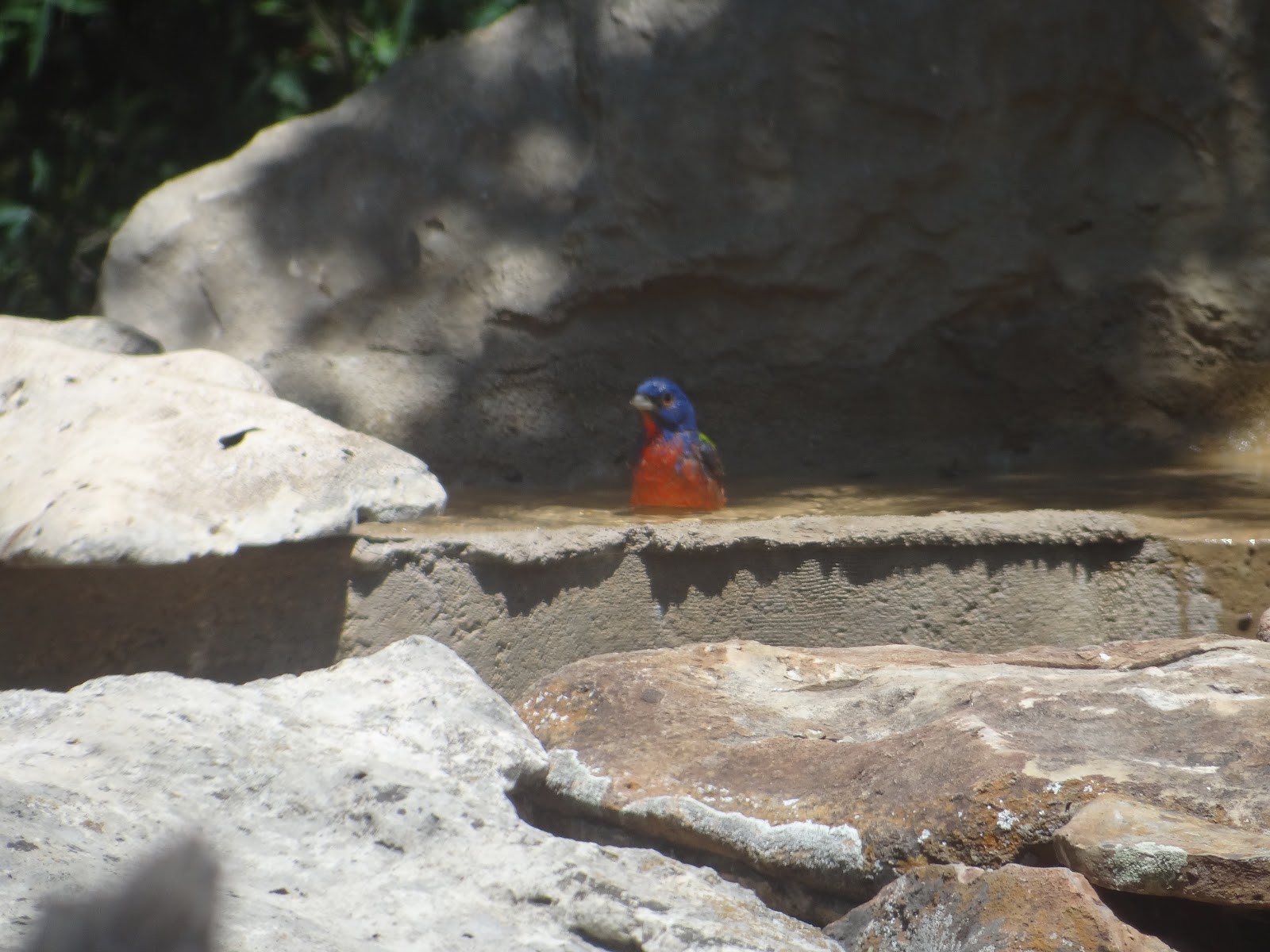
Male Painted Bunting at South Llano River State Park
We got to Davis Mountains State Park around 8:30 that night. We quickly pitched the tent and rushed over to campsite 3, to see the Elf Owl that nests on the post there. A scope was set up, and one of the people staying at the site put a flashlight up against the post to illuminate the hole without disturbing the nest. After a long wait, we finally saw a bird zip through the twilight, and a bird appeared in the hole as well. Elf Owl! At that point it was the best bird of the trip. We were overjoyed to have gotten amazing looks at a bird that isn't super easy to get unless you find a nest.
Alex got an amazing picture of the Elf Owl considering it was dark outside. Dude can digiscope like no other.
The next morning we got up and put in 8.5 miles on Sheep Pen to the Limpia Creek Overlook. We had a ton of great birds on the trail. Phainopepla was abundant along Limpia Creek, and we had Greater Roadrunner once we got up on the mountain. A great find coming up was Cassin's Kingbird, although it wasn't until after the photo that we could tell what it was. Tons of sparrows were flying around, but of course they never wanted to get close enough to let us ID them. The highlight of the morning was easily Western Tanager, although it was a quick look.
The white on the tail tip is a way of showing that this is Cassin's Kingbird instead of Western Kingbird

Phainopepla at Sheep Pen

Greater Roadrunner
After Sheep Pen we went to the drugstore in Fort Davis for some incredible food, we went back to the blinds for a few hours. We figured it was too hot for the birds to be out, and the water at the drips would get some birds. We had great looks at Hepatic and Western Tanager, Woodhouse's Scrub Jay, Canyon Towhee, Lesser Goldfinch, Scott's Oriole, and Black-headed Grosbeak. The blinds are amazing here and should be visited.
Acorn Woodpecker at the blinds 

Black-headed Grosbeak

Canyon Towhee

Scott's Oriole

Woodhouse's Scrub Jay
The next day we went to Madera Canyon, high up in the Davis Mountains as part of The Nature Conservancy's area. The trail is the only one open year round, and they rest of the preserve is open only on select weekends throughout the year. There are pretty views, but Alex and I both felt really uneasy on the hike. We have no clue why. The area is pretty remote, and according to a local we are in places "where we can see some things we don't want to see." There is a high density of mountain lions in Jeff Davis county, and at the top of the trail we were at about 6200 feet. Sul Ross St. studies have shown that we were most likely in mountain lion habitat, and our elevation was about 100 feet below what to expect for a lion. I for sure wouldn't do Madera Canyon without a partner, but it's a nice trail, although it wasn't as birdy as it seemed on eBird.

For the most part we had a lot of the usual stuff. Rufous-crowned Sparrow, Hepatic and Western Tanagers, scrub jays, etc. Best sighting of the day was a likely Dusky Flycatcher, and I am confirming that on Texbirds now. My other guess would be a Gray Flycatcher. EDIT: David Sarkozi knows way more than I do and he is leaning Gray, and his reasoning is the bird is more pale and gray than a Dusky, which after looking I think he's right. The bird is also more uniform in color than a Dusky would be. We also had Western Bluebird and Swainson's Hawk. Pretty good sightings, and a great last bird was Plumbeous Vireo. 
Gray Flycatcher

Hepatic Tanagers are going to be darker along the wings compared to a Summer. Bill color is also different.
We returned back to the blinds after a lunch. Great looks at the usual birds, but right as we were getting up to leave we saw a flash of baby blue. I've skimmed the field guide enough times to know what it was. I freaked out, Lazuli Bunting! It was a bird I wasn't expecting at all, and it was a top 5 bird of the trip. Later that night we went up Skyline Drive, where in addition to stellar sunsets and stars we got Common Poorwill and Common Nighthawk. In addition, we had Great-horned Owl on the telephone poles the night before. We really cleaned up on our nocturnal birds. We only missed Western Screech Owl and Flammulated Owl, which is a really rare find. I don't think Western Screech is common in the park either.
Had some dust on the lens for this one, but I went wild over the Lazuli Bunting

Lesser Goldfinch

I debated all night over whether Elf Owl or Lazuli Bunting was the better find. It didn't matter on our last day. We got up to head back to College Station, but we stopped for 30 minutes at Balmorhea Lake, which is on the way back to I-10. It's a small lake, and we were going after Clark's Grebe and Western Grebe. Balmorhea is one of 3 places to reliably get Clark's Grebe. Western Grebe appears to be a little easier to find, but both can really only be reliably found at Red Bluff and McNary Reservoir and Balmorhea Lake, all in the Trans-Pecos. 

We got a weird route that tried taking us through private land, and we're quite thankful it took us on the wrong route. We had 2 falcons fly overhead. They were too big for American Kestrel, but for sure not Peregrine Falcon. The tail banding and yellow near the legs left one option: APLOMADO FALCON!  It's a really rare bird for the area, and we were bumpin after we looked at the field guide. Once we got on the right route we had Pyrrhuloxia and a possible Varied Bunting, but it was too tough to ID it. We got both Western and Clark's Grebe and some Scaled Quail. What a fantastic way to end the trip!

Overall we had a fantastic trip. I added 34 year birds, and we had a total of 58 species, a good haul. I'd recommend in the future doing this in addition to Big Bend. We stretched it out and had a great time, but solely to maximize species I think we saw most on the first day, then added some others as it went along. The general habitat of Davis Mountains SP and Madera Canyon is all pretty uniform, but if you go during an open weekend at the preserve you'll get way different elevations, which bring a ton of new birds into the mix. South Llano River is a place we'd like to have more time at, as 12-2 is not ideal, but if you go in the morning you'll for sure get Golden-cheeked Warbler and Black-capped Vireo. 

Best Birds: Black-capped Vireo, Elf Owl, Lazuli Bunting, Aplomado Falcon, Clark's Grebe, Gray Flycatcher, Mountiain Chickadee
Misses: Montezuma Quail (good luck finding that one), Golden-cheeked Warbler, Zone-tailed Hawk, Common Black Hawk, Grace's Warbler. All were going to be difficult finds outside of Golden-cheeked, so overall pretty successful
Clark's Grebe

Scaled Quail

Western Grebe


Ecuador Part 1

I am shocked this trip happened. When Sydney was born, I expected about 2 years of not doing a birding focused trip, but I have a very suppo...